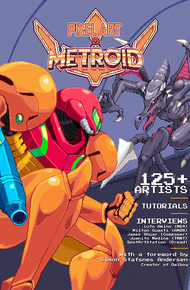
Excerpt
Foreword
Pixel art is often difficult to explain. Sure, you can define a pixel as the smallest point on a digital screen and compare the artform's history to mosaic tiles and cross-stitching for a way to ground it in traditional media. But unlike most other media, pixel art is unique in that it is completely locked to the confines of its digital restrictions. With most artforms, you can present it in any number of ways, and it will still remain that same artform. A painting can have physical texture and can be painted on any number of surfaces. A sculpture can exist in a multitude of shapes and materials. Even mosaic tiles are not required to have specific shapes, and cross-stitching can have interwoven threads that can blend and weave beyond the
traditional canvas.
But not pixel art. Here, changes threaten to break its fundamental properties and make it something else. If you stray from the square pattern and go off the grid, something feels off. If you add too many colors and make the pixels too small or too many, definitions start to blur. If you print it or turn it into a 3-dimensional piece, can it still be labeled the same as the digital square it came from?
Throughout my career, I've heard people disagree on these points. The confusion stems from the fact that pixel art has a trait that both restricts it and defines it:
Limitation.
In its earliest incarnations, pixel art was simple and relatively easy to understand. It was digital squares arranged in a pattern that gave an abstract representation of something, limited by that machine's graphical capabilities. Because old computers and consoles were only capable of so much, often the artist's skill was proven by how much they could do with the limitations placed on them. I've often said that pixel art is the process of getting as much as possible out of as little as possible, and that sentiment is usually carried over from these early machines where the rules were straight forward. However, with the leap in computing power, we're faced with a different problem: There is no limit anymore. You can have as many colors as you want. As much space as you want. Use any method you want. Any limitation there was now has to be self-imposed.
Then what exactly is the appeal? After all, if any and all limitations, the fundamental principle on which the artform rests, is no longer a requirement, why keep making it?
I've often wondered how I would explain what makes pixel art interesting to work with. After all, dots on a screen might seem like a pretty cumbersome way to create something interesting. But there's another aspect to it that is often overlooked: Pixel art is fundamentally about abstraction.
Growing up with the earliest versions of computer and console games, I found that they were able to give just enough of a glimpse into what the world could be, but never the whole picture. It was a bizarre space where you got to live in a book. Forming the true image in your head, like blocky impressionism that actually moved.
When the first exploration games came out, the images were minimalistic, and like every good book, your mind raced to fill the gaps so you could see the world in full. Dark corridors, alien planets, and monsters from other worlds seemed strange and daunting, because they could be anything depending on the observer's imagination. Part of that same exploration was seeing these same games evolve with their hardware and if the landscapes your mind had painted matched where its worlds would go next.
That journey is still ongoing, despite the vast changes in technology and the shifting role of the artform with new generations. There, in the middle of it all, lies the wonder with pixel art:
You create something, but never everything. Its rules are rigid, but unclear. And through some
paradox, the more you strip away, the richer its world can become.
Simon Stafsnes Andersen
Art Director at D-Pad Studio, Creator of Owlboy