Cheryl S. Ntumy is a Ghanaian writer of speculative fiction, young adult fiction and romance. She is part of the Sauútiverse Collective, which created a shared universe for Afrocentric speculative fiction, and a member of Petlo Literary Arts, an organisation that develops and promotes creative writing in Botswana. Her Sauútiverse novella Songs for the Shadows was published in 2024 by Atthis Arts and her short story collection Black Friday and Other Stories from Africa was published in March 2025 by Flame Tree Publishing.
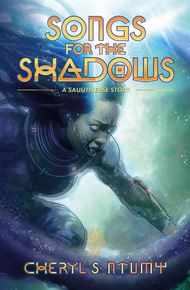
Shad-Dari has escaped her past, her dreams now in reach. An excavator of the valuable old sounds of "rino-Rin, she steals tiny, unheard fragments of the sacred songs to erase the painful echo of her home planet, Ekwukwe. In one rebellion too far, she sets off a chain of events that severs her from time itself, forcing her, without another way forward, to face her past.
A lyrical, immersive story of time and life and grief, set in the gorgeous depths of the Sauútiverse.
"Set in the Sauúti universe and tightly packed with rich worldbuilding, Songs for the Shadows is crafted in beautiful prose and depth, meditating on silence and sound and song as powerful cultural entities—a magic system of sound excavation and the folding and manipulation of time that blew me away!"
– Tlotlo Tsamaase, Caine Prize Finalist"In Songs for the Shadows, Ntumy continues the work of the Sauúti Collective, in immersing the reader into an expansive and complex world in which the magic and power of the oral—prayers, wails, chants, songs, words, and therefore stories—have been elevated to the most valued cultural artifacts. I was mesmerized by this world and by the rule-breaking, self-inventing Shad-Dari who, in seeking to drown out the echoes of her past loses everything she thought she needed."
– Gothataone Moeng, 2024 Whiting Award winner for Call and Response: Stories"Cheryl's writing is magical, lyrical and breath-taking. Imagine a world created by and out of sound – and that sound is linked to our very beings. Plus the beautiful evocations on the non-linearity of time and how we deal with the voices from the past. Bravo!"
– Joyce Chng, author of Fire HeartSome names were not meant to be spoken.
In many places all names carried vulnerability. People kept their true names hidden away, like drums of sacred sound. But in the caves of Tifaritu, on the planet Ekwukwe, names carried a person's essence and to speak them was a mark of respect. The Tifariti did not fear the names of their own.
Growing up in the unyielding echoes, born in darkness shielded from the sky, they knew the difference. Ravenous otherworldly beings that could not be seen, or worse, could not be heard—to utter their names was to summon them, and once they came they swallowed you whole, echo and all, and no trace of you would ever be found.
Those names you never spoke.
The stand-in for such monsters, such names, was Tlalala, a word that embodied an insatiable appetite, for it echoed forever. One could begin it and never cease, tongue locked in an endless dance—Tlalalalalalalalalalalalalala—until the end of time.
Tifariti children would hide deep in the network of caves they called home and dare each other to say it, testing how long they could draw it out before their breath gave out or their heads spun, or an adult overheard and came running to silence them. Even the stand-in name was dangerous, the elders said. A slippery slope. Not something to be toyed with.
Despite the warnings, or maybe because of them, Sha'dar'dar Se'seruwa toyed with the name daily, turning it over and over in her mind, trying to catch a glimpse of the true name it represented, or even the creature the true name signified. Sometimes, when she looked out of the corner of her eyes just so, she could swear she saw something on the periphery of her vision, some shift in the air. She could almost hear the faintest strains of a call on the wind.
She was not afraid of hunger. Sometimes she felt as though she were made of it, as though it laced the very air she took in. The second youngest of twelve children, with seventeen cousins, Sha'dar'dar was lost in a sea of dusty bodies and gaping mouths. She found the caves loud and oppressive—the crevices the children squeezed into at night, the hollows the adults claimed for sleep and storage, the huge cavern where the whole community gathered for market day, meetings and celebrations. She woke early each day to escape them.
Up, up, up. The sky and open air beckoned, along with the countless stars that seemed to sing her name. She would run through the network of caves, crawling through tunnels, fleeing past the spring near the marketplace, ducking neighbours as they emerged from their hollows, climbing up the rocks until she emerged at the top of the hill. She would scurry round to the other side of the hill and shout "Tlalala" with all the force of her echo behind her, daring the monsters to reveal themselves so she could witness something, something epic and important at last, something beyond the world of dust and noise and stone and half-full bellies. They never emerged. The name would die, snatched up by the wind, drowned out by the calls of wild beasts and echoes bigger and stronger than Sha'dar'dar's.
She was never home, if she could help it. Not when there were chores to be done, or decisions to be made, or rare feasts to be shared. So, at the age of fourteen, she wasn't home when a gang of amateur sound miners accidentally brought down three caves, crushing two families, including hers, to death. It was almost dusk when she returned from gallivanting to find a crowd still clearing away the rubble.
One of her aunts and three of her cousins survived, calling her to them from the bloodied blankets wrapped around them, through the crowd of wailing onlookers.
"She lives! Thank the Mother!" And they smothered her with relief.
Instead of comfort, they brought her pain. It was as though their echoes had swollen to contain the echoes of all those they had lost and the world had become louder than ever. A world of scurrying footsteps where there were no feet and whispers where there were no mouths. A new cave, smaller than the crevice she crept into each night. Sha'dar'dar couldn't breathe, let alone grieve.
Up, up, up! The call blossomed into a wild and desperate thing, fighting to be heard over the clamor of phantom echoes, until she could no longer bear it. So, she left.