With a 30-plus-year career in consulting, Nettles has advised a diverse range of clients, from startups to Fortune 100 companies in financial technologies, media, entertainment, and green technologies. His work focuses on privacy, futurism, and disruptive technologies, exploring how these elements influence both businesses and individuals. In addition, he is a founding partner in Myriad Technology Group and Myriad Labs, offering business and technology solutions to small and medium sized businesses using principles of gamification, data analytics, and Gen AI.
He is also a multi-genre speculative fiction and fantasy author, and non-fiction author of business, technology, privacy, business continuity and DR. He is also a founding partner of Author Essentials, an organization dedicated to providing resources and workshops for authors to navigate the business aspects of writing. He can be found at JamesPNettles.com, AuthorEssentialsWorkshops.com, CreatingPros.com, and the Con-Tinual Online Convention.
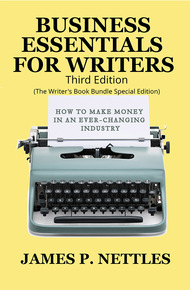
Business Essentials for authors is your business 101 guide for the publishing industry, whether you have never published at all or are looking to take your professional career up a notch in an easy to read and conversational way. The book covers the five pillars of business:
• Meet all of the people and jobs in the publishing industry, and how they fit together.
• Building the foundation of your business and career, including paths to publication (New York publishing, small and mid-tier presses, and self-publishing), answering the burning question, what is an author platform and how to create yours, and how to develop your plan.
• Understanding sales and marketing in publishing, how and where to sell books, and developing your personal and author brand.
• Establishing all of the operational side of any business from contracts and intellectual property, working with different tools and technologies (including social media), and how to design and build your website.
• Learning how money works as an author, basic accounting, and making more money
The second edition includes a look at Generative AI, the problems, and ethical use of the emerging technology.
We look at all this and more from a long-term strategic view, how to get the plan done, and the mindset to make it all work.
"I wish I'd had this book when I started my writing career"
– Gini Koch"I've read many books on writing and many books on business, but never one that combines the two so perfectly. Jim's book covers both what you need to do as a writer and what business knowledge you will need to succeed in writing. This book covers how to operate, market and finance your writing. If you are serious about making money with your writing, I highly recommend this book."
– John LaPoint"This book is essential for anyone trying to make a living from their writing. There's more information presented than I can go into in a review. The book offers a high-level overview of all aspects of the writing business. It goes over everything from websites, marketing, and accounting and less common topics like trademarks, public domain, and writing a business plan."
– Sidestreet PublishingIs Your Business Taking You for a Ride?
"A successful man is one who can lay a firm foundation with the bricks others have thrown at him."
― David Brinkley
I met David Brinkley when I was in college. I covered a speech he was giving for the University of South Carolina (the same way I got to meet many people and be exposed to a lot of ideas), and while I don't remember a lot from his speech, I do remember the tone and confidence in his voice as he remembered some of the challenges he had faced earlier in his career. The part I do remember was him talking about building a solid foundation for yourself, your life, and your career.
At the time, I also volunteered in the Small Business Center at USC and did work with people who were trying to start their own small businesses, from coffee shops to copy shops, and mostly other retail type work or micro-manufacturing. Even today, I know a lot of business owners, and the question comes up, "What is a business?"
Most people will say "I write books," "I create art," or "I develop games." These are not businesses. These are products and services. Any business, every business, whether an author cranking out books or a multinational manufacturing conglomerate is the same thing. The business is nothing more than the people, framework, and processes that allow you to move forward and accomplish your goals. In other words, a business is nothing more than the engine that takes in time and resources and generates money. The question is how efficiently does your engine run, and does it give you more of a return than what you put into it?
As an author, it is difficult, nigh impossible, to separate yourself from your business. But remember, you are not your business. Your business in the publishing world is to help bring the written word to a given audience. Your job in the business is to make sure someone is wearing the needed hats, even if it is all just you. But you still need to remember—your business is a separate, living, breathing organism. One that exists to serve you and your interests, not the other way around.
From a 101 perspective, there are really only five parts to any business. Think about it like a riding a bicycle.
You'll find there are many different types of rides, for every purpose and every budget. Your ten speed probably will not survive a hard mountain trail. Not every business model serves every business.
This book (and the program it is a part of) is based on the structure of a business, with each chapter and topic designed to help you develop your business plan to have a model to follow and in such a way that you can see and focus on each of these factors and develop a sustainable business in the publishing industry. By working through each section of the plan, we address not only the plan but the actions to take, the approaches and attitudes to use to be successful, and general business practices.
I know this may look a little daunting, but we're going to break all of this into pieces and come at it from a few directions. If we think about business structure like a bicycle, there are with five core areas of business:
1.The People are the core, not only of any business, but of society as a whole. We ride together. Without other people, not only can we not make and deliver good work, but we have no one to buy it from us. This would be not only our authors, editors, and artists, but also agents, publicists, accountants, bookstore staff, and of course, our readers. Every person involved in the journey of any given product from the person with an idea to the one who buys it depends on the wheels turning. With the people component, what you really need to understand is not only their mindset, but yours as well. Thoughts dictate action.
As the CEO, you are the most important person, and your mindset is the core of your business. It gives us vision, creativity, drive, and keeps us going when we don't think we can. The good news is that if the worst happens and we have built a solid foundation, you have a place to start from. If we expect the best, the more likely we are to get it. Buckle on your helmet and keep it safe.
2.The Foundation is a lot like the frame. Everything attaches to the frame in some way or another, and it has to be able to support everything it carries to get us from one place to another, but it can't take us anywhere on its own.
a.The core of the Foundation is the vision that the founders and leaders hold for the business to give it purpose and the customers it looks to serve.
b.The strength of the business comes from the knowledge, skills, and drive to see the business succeed.
c.The architecture defines the processes and methodologies used by the business.
d.A solidly constructed Foundation can be used over and over again, only needing tweaks and modifications to deliver new and different products and services to your end customer instead of having to start from scratch.
3.Sales and Marketing are like the bells, whistles, and lights, or trading cards you put in the spokes to announce your presence, and even the paint and racing stripes to "give you speed" and make you look good. Maybe it is the flowery basket on the front. It is any way you are making potential customers aware of you, your work, and your products, and to communicate who you and your brand are. It is how you connect with your readers to find what they want from you. It is every way in which you interact with them, be it in person, social media, or your website.
4.Technology and Operations are the wheels on your bike. They are what keep you rolling uphill and downhill. They represent a fundamental and revolutionary technology that encompasses everything about delivering a final product to your customer. It is scheduling an appointment with your editor to review your latest book, sitting at a convention to network or sell books to publishers, it is uploading your manuscript and cover to Amazon. If the wheels aren't turning, your business isn't going anywhere. Occasionally, you need to be ready to change a flat tire.
5.Finance and Accounting are the handles, chains, pedals, and brakes that turn your effort into results. We have to pour our resources in to get energy out and use those tools to steer. Ultimately, making money is the goal of any business and differentiates a business from a hobby.
When you first start to ride, you have to learn balance, how to lean into a turn, how to pedal uphill and coast downhill. You have accidents. You fall over. You have to learn how to stop. Business is no different.
Another hard lesson is learning to control the bicycle. The biggest mistake I see entrepreneurs make is that they create themselves a job but do not see themselves as business owners or CEOs. When you have a job, someone else is giving direction, and at the end of the day, you leave the job and go home. You can always get another job somewhere else. Owning a business is like raising a child. It means continuous care, feeding, and attention until it's big enough to take care of itself for periods of time, or you have trusted people who carry some of the responsibility. Once you put that kid on a bike, you cannot always control where it goes, but at the same time, you can get a lot from the ride.
It is worth noting, many of the topics will touch more than one of these areas and know that People are a part of every step of the way.
As you progress through the book, we tackle each of these sections with four focuses:
1.Mindset is the attitude and confidence to use your intelligence, talents, and skills to meet your goals.
2.Strategy is a vision, creating a plan, and working toward your long-term goals.
3.Tactical Actions are the steps you take at (hopefully) the right place and the right time to execute your strategy.
4.Operational Actions are the day to day and regular routines of business, linking your strategic plan to your tactical actions.
Think of this book like the training wheels and helmet. Even after you have been riding for years, you still sometimes will crash, often through events outside of your control.
You may have noticed the one thing I did not mention. Your product. Your book. Your ebook. The audiobook. TV and movie rights. Merchandizing rights. Services. Appearances. Voice work. Sketching Deadpool as a pledge in Animal House.
A properly structured business, even if you're the only staff, allows you to develop different goods for sale. If you are going to have a run for the long term, you will need it, so build a model that can change and grow with you. Sometimes you have to replace tires and rims. Sooner or later, it's time to upgrade.
If you don't take anything else away from reading this book, here's the most important lesson I've ever been taught: get rid of the idea that you can't fail if you don't try. It's the exact opposite. If you don't try, you can never succeed. Stretch your boundaries and leap past that comfort zone. Keep the first aid kit handy for the many bumps and bruises along the way and keep on going.
As much as I'd like for this to be a one-stop manual on business, it's going to be just one resource and guide in your journey. It's meant to be a first step to give you the basics and tell you what you do not know, not to turn you into a master. That will take a little more time.