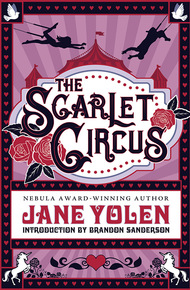
Jane Yolen has been called the Hans Christian Andersen of America and the Aesop of the twentieth century. She is the author of over three hundred and sixty five books, including children's fiction, poetry, short stories, graphic novels, nonfiction, fantasy, and science fiction. Her publications include Owl Moon, The Devil's Arithmetic, Briar Rose, Sister Emily's Starship and Sister Light, Sister Dark. Among her many honors are the Caldecott and Christopher Medals, multiple Nebula, World Fantasy, Mythopoeic, Golden Kite, and Jewish Book awards; as well as the World Fantasy Association's Lifetime Achievement Award, and the Science Fiction Poetry Grand Master Award. Yolen is also a teacher of writing and a book reviewer. She lives in Western Massachusetts and St. Andrew, Scotland.
For The Emerald Circus
•2018 World Fantasy Award for Best Collection
Jane Yolen's career awards
•1968Caldecott Medal(forThe Emperor and the Kite, illustrated byEd Young)
•1987 Special World Fantasy Award (forFavorite Folktales From Around the World)
•1988Caldecott Medal(forOwl Moon, illustrated byJohn Schoenherr)
•1992 The Catholic Library Association'sRegina Medal(for her body of children's literature
•1999 Nebula Award for Novelette (for "Lost Girls")
•2009World Fantasy Award for Life Achievement
•2017Damon Knight Memorial Grand Master Award
The Scarlet Circus, the fourth volume in Yolen's award-winning short fiction series brings you passionate treasures and unexpected transformations. This bewitching assemblage, with an original introduction from Brandon Sanderson, is an ideal read for anyone who appreciates witty, compelling, and classic romantic fantasy.
A rakish fairy meets the real Juliet behind Shakespeare's famous tragedy. A jewelry artist travels to the past to meet a successful silver-smith. The addled crew of a ship at sea discovers a mysterious merman. More than one ignored princess finds her match in the most unlikely men.
From ecstasy to tragedy, with love blossoming shyly, love at first sight, and even love borne of practical necessity—beloved fantasist Jane Yolen's newest collection celebrates romance in all its glory.
"For this whimsical collection, World Fantasy Award winner Yolen (The Midnight Circus) brings together 11 fantastical shorts centered on romantic love. Yolen's trademark fairy tale styling is on display throughout, with vivid, pithy prose animating each quirky flight of fancy."
– Publishers Weekly"The Scarlet Circus is a magical collection of love stories, where love is often an act of courage and intelligence. Jane Yolen has a true storyteller's voice—a voice that makes the writing disappear so that only the stories remain."
– Anne Bishop, New York Times bestselling author of the Black Jewels series"All these years, and Jane Yolen still reduces me to helpless, gibbering admiration. I'll read anything with her name on it, even if it's just a damn grocery list!"
– Peter S. Beagle, author of In CalabriaA Little Bit of Loving
Introduction by Jane Yolen
When asked what I write by researchers, interviewers, school children, adult audiences, and people I meet at conferences, I normally answer, "Everything!" But then I hesitate charmingly and add, "Except sport stories, cowboy stories, and romance novels."
But I am lying. (Definition of an author/storyteller = liar. It runs in the family.)
You see, I have published well over 400 books, plus thousands of poems and a huge basket load of stories. So when I really want to parse that answer, I need to think about my output. And then I remember that way (back in the 60s/70s/80s) I published two children's picture books about baseball. So, yeah, I have written sport stories.
Even earlier, I wrote a children's picture book about the wild(ish) west. It had tumbleweeds and all.
But no romance novels. When asked, about that, I reply: "I am in my mid-eighties. The research alone would likely kill me."
However, I have a brand-new husband after fifteen years of widowhood . . . who knew!!! And there is a lot of "interesting" research on love and love affairs available, and I have spent years on other research projects (including three Holocaust novels), none of which have killed me.
But that begs another question: I am also forgetting the many short stories and poems in the SF/fantasy genre that I have published over the years in magazines, collections, anthologies, many of which have a romantic tinge or a full-out romantic assault as the through-line. Yeah—not romance novels, but a lot of romance all the same. Many of those stories (my favorites) you will find in this book.
And I have also written songs of love as well, a number of which of which have been performed by bands.
The difference is that these stories are either science fictional or fairy tale-ish or fantastical. Humans fall in love with mermaids or mermen, or selchies or fairies or half-breed redcaps, or magical birds or magicians or . . . hard to rule anything out when you write genre.
And, come to think of it, some of my SF and fantasy novels include long and involved romantic storylines, like Briar Rose which is based on the fairy tale but set in the Holocaust, or like the Great Alta Saga that has magic and a prince, or like The Curse of the Thirteenth Fey, which is full of fairies (not the little people with wings kind though), or like Except the Queen, co-written with Midori Snyder, and that book includes a romance between a couple of middle-aged fairies and humans.
OMG—I HAVE written romance novels. Turns out I am a complete romantic! Who knew!
However, please note: there's a difference between "romantic novels" and capital R Romance Novel. The former has a measure of love story woven into its arc (think of War and Peace) but it is not just about the love story . . . or the lovers that you thought it was going to be about. But a Romance novel is driven entirely by the love story, even though there may be a decoration of history draped over its shoulders. The Romance Writers Association's definition of the genre, which is capital-R Romance, is quite specific: "a central love story and an emotionally satisfying and optimistic ending." As you can see, they are quite rigid in the happily-ever-after aspect expected in each novel, whereas the stories in this book may have sad endings, compromised endings, or joyous ones. In other words, real life. Except also magical and fantastical and science fictional . . . of course.
So, I guess I have to redirect those questions from researchers, interviewers, et al to say that I have written fantastical stories and books that include Romance as well as True Love, with a bit of snogging and touching and kissing and other stuff. And if this makes me a writer of Romance Books, then perhaps we need to redefine the concept, not redefine me.
So—here's a challenge: using a few common definitions of love and romance culled from the Internet, how do they wrap their loving arms around the stories in this book?
Here is Google's definition: "A feeling of excitement and mystery associated with love." What about how I love my Prius? My dog? Or my grandkids? My country? No romance here but still love.
This is Wikipedia's basic definition: "Romance or romantic love is a feeling of love for, or a strong attraction towards another person, and the courtship behaviors undertaken by an individual to express those overall feelings." The term "person" is so human-centric. What about those selchies and mermaids and . . . ?
The Wikipedia entry also includes this definition from the Wiley Blackwell Encyclopedia of Family Studies: "Romantic love, based on the model of mutual attraction and on a connection between two people that bonds them as a couple, creates the conditions for overturning the model of family and marriage that it engenders." Why just people? Why just two? And again, we have a human-centric idea (and ideal) of a love relationship. Building a family when one of the partners is a selchie or a mermaid or a redcap means having to redefine—through story—the definition of love (and also the definition of 'people'? Lots of science fiction romances count the non-human as 'people'). Of family. Of sex or contentment or passion. Or release.
However, I am a storyteller, not a sex counselor. I am not writing these stories to help anyone, or to lecture on how to create a permanent relationship with a ghoul, or have an extra-marital affair with a ghost. I am simply telling a story. If along the way it entertains, amuses, even arouses, or touches the reader deeply, then my work is well done.