Jonathan Strahan is an award-winning editor, podcaster, critic, and publisher from Belfast, Northern Ireland. He has edited or co-edited more than seventy anthologies and twenty short story collections. Strahan has received the World Fantasy, Aurealis, Atheling, and Ditmar Awards. He is currently the Reviews Editor at Locus Magazine, and a consulting editor for Tor.com. Strahan lives in Perth, Western Australia, with his family.
2024 Aurealis Awards shortlist
Esquire's Best Sci-Fi Books of 2024 (So Far)
Locus Award Finalist
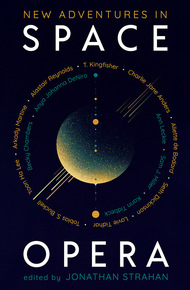
Ann Leckie / Becky Chambers / Alastair Reynolds / T. Kingfisher / Charlie Jane Anders / Sam J. Miller/ Anya Johanna DeNiro / Yoon Ha Lee / Lavie Tidhar / Tobias S. Buckell / Arkady Martine / Aliette de Bodard / Seth Dickinson / Karin Tidbeck
Award-winning Australian science-fiction editor Jonathan Strahan (The Best Science Fiction of the Year series) presents the quintessential guide to the exciting New Space Opera. This skillfully curated, must-read volume gathers fifteen dramatic, newly classic interstellar adventures from some of the most highly acclaimed and popular speculative-fiction authors.
In "Zen and the Art of Starship Maintenance," a cloud-based contractor finds a human war criminal clinging to the hull of the ship. The clones of "All the Colours You Thought Were Kings," about to attend their coming-of-age ceremony, are also plotting treason. During "A Temporary Embarrassment in Spacetime," two outlaws go on the run after stealing a device from a space cult.
Take a faster-than-light trip to the future. Discover where memes rise and fall in moments. Here are the new, adventurous, and extremely efficient takes on interstellar battles, sentient spaceships, and galactic intrigue.
A fantastic anthology of space opera stories by writers from around the world! – Lavie Tidhar
"There is no better or more expert editor working in SF; impeccable taste, great range, excellent choices. Anyone interested in space opera will want to buy New Adventures in Space Opera."
– Adam Roberts, author of The This"An excellent choice for fans of better-known space operas like Dune, Leviathan Wakes, or Guardians of the Galaxy."
– Booklist"Throughout, plentiful action, enigmatic and complex worldbuilding, sinister technology, and vast space vistas impress. It's a gift for sci-fi lovers."
– Publishers Weekly"SF readers used to seeing space opera as multi-doorstop series will find a lot to love in this collection of skillful short works in a popular subgenre. Fans of the featured authors will love seeing their favorites' work in shorter forms."
– Library JournalIntroduction: "From the New Space Opera to Here . . ."
by Jonathan Strahan
Robert Silverberg identified two fundamental themes in science fiction: the journey in time and the journey in space. Space opera, he suggested, was a sub-genre of the journey in space, one that takes romantic adventure, sets it in space, and tells it on a grand scale. Many have tried to define space opera since Wilson Tucker dismissively coined the term in 1941 to refer to the "hacky, grinding, stinking, outworn, spaceship yarn," from Brian Stableford in The Encyclopedia of Science Fiction describing space opera as "colorful action-adventure stories of interplanetary or interstellar conflict' and Jack Williamson in The New Encyclopedia of Science Fiction referring to it as "the upbeat space adventure narrative that has become the mainspring of modern science fiction", to Norman Sprinrad amusingly (and not entirely incorrectly) calling space opera "straight fantasy in science fiction drag."
Perhaps getting closer to the feel of it, Paul McAuley in Locus's special 'New Space Opera' issue referred to the "lushly romantic plots and the star-spanning empires to the light-year-spurning spaceships, construction of any one of which would have exhausted the metal reserves of a solar system, . . . stuffed full of faux-exotic color and bursting with contrived energy." Space opera is, in short, romantic adventure set in space and told on a grand scale. It must feature a starship, the most important of science fiction's icons, which, as Brian Aldiss wrote in the introduction to his anthology Space Opera in 1974 "unlocks the great bronze doors of space opera and lets mankind loose among all the other immensities." It is the tale of godlike machines, all-embracing catastrophes, the immensities of the universe, and the endlessness of time. It is also, to go back to Williamson, the "expression of the mythic theme of human expansion against an unknown and uncommonly hostile frontier."
For all the riffs and variations on space opera that have been tried over the one hundred and thirty or so years since the first proto-space operas appeared in the 1890s, it has always fallen somewhere within those boundaries. I know that when I sat down to try to decide what should or should not feature in this book, I used several guides. First, a space opera should primarily take place in space, either on ship or station, and only occasionally touchdown on a planetary surface. Second, it should take place in a populated universe. When the protagonist of the story ventures forth, they must encounter someone. And, finally, the stakes should be high. The stakes could involve E.E. Doc Smith's smashing of galaxies or Aliette de Bodard's breaking of hearts, but it should feel like the world might, emotionally or physically, be about to end.
That sets our boundaries. The kinds of stories that were published as space opera—our thoughts about the empires they took place in, the nature of the starships, their composition of their crews, and the adventures that they undertake—have changed since stories like Edmond Hamilton's Interstellar Patrol yarn "Crashing Suns" appeared in Weird Tales in 1928. Bright, garish stories of the pulp magazine era that were driven by both a sense of techno-optimism and manifest destiny that seems, at least from the outside, to have been common in the United States in the 1930s, 1940s, and 1950s—work like E.E. "Doc" Smith's Skylark of Space and A. E. van Vogt's "Black Destroyer"—which would give way to more sophisticated, challenging work like C. L. Moore's Judgment Night or Alfred Bester's The Stars My Destination.
The 1950s was a time of change for science fiction, when the end of the pulp magazine era meant a move from primarily being a short fiction form to being published at novel length by major publishers to great success, though it would be some years later before it appeared regularly on bestseller lists. This change began as writers like Leigh Brackett, Jack Vance, and Cordwainer Smith brought new sophistication to the field in the 1950s and 1960s with enduring works of space opera, like Frank Herbert's classic bestselling Dune which appeared in 1965. Brian Stableford observed that by the late 1950s a number of the tropes of space opera, like the galactic-empire scenario, had become a standardized framework available for use in entirely serious science fiction. "Once this happened," he wrote, "the impression of vast scale so important to space opera was no longer the sole prerogative of straightforward adventure stories, and the day of the 'classical' space opera was done." Which didn't mean that those 'classical' space operas stopped being written or published. Most notably during the 1970s the sprawling novels of Larry Niven and Jerry Pournelle, especially the award-winning The Mote in God's Eye, and possibly the most popular space opera of the following decade, first appeared in Orson Scott Card's novella Ender's Game, but there were changes. Space opera became darker and more political. In 1975, M. John Harrison wrote The Centauri Device, a novel that turned the conventions of space opera on their head. It was, apparently, intended to kill space opera, or at least intended as an anti-space opera. What it was, instead, was the work that provoked others to pick up the cudgel and change things again.
By the time British magazine Interzone published a "call to arms" editorial looking for radical hard SF in 1982, a new generation had come along ready to do just that. First among them was Iain M. Banks, whose Consider Phlebas was boldly, defiantly operatic in nature and scope, and yet very much leftward leaning politically. His sequence of science fiction novels involving the "Culture" set both the critical trend and the commercial standard for space opera in the early 1980s. Unlike many of his contemporaries, Banks wrote almost exclusively at novel length.
This newer space opera, though, wasn't a technological fable from the turn of the century. By the beginning of the 1980s, when cyberpunk was emerging in the United States, it no longer seemed relevant to many writers to tell bold tales of space adventure that looked to new frontiers where a sense of manifest destiny brought "civilization" to the locals. Colonialism and the drive to build empires was becoming much less acceptable, and the universe looked a much darker place. Space opera was no longer looking to go out and take over the universe: it was looking to survive in it. This change can be seen in the work of Stephen Baxter, Paul McAuley, and even Colin Greenland. McAuley's Quiet War and Jackaroo sequences of short stories and novels, and Alastair Reynolds' Revolution Space short stories and novels were key works here, retaining the interstellar scale and grandeur of traditional space opera, while becoming even more scientifically rigorous and ambitious in scope.
Two critically important writers emerged in the United States during this period. C.J. Cherryh began publishing in the 1970s and hit her stride with military space opera, Downbelow Station, in 1981. Her Union-Alliance series of novels brought a detailed rigor from the social sciences to space opera that had rarely been seen and which would drive the major series of her career, the sprawling Foreigner sequence. Lois McMaster Bujold appeared on the scene in 1986 and quickly established the Miles Vorkosigan series of military space operas as some of the most important of the time with stories like "Borders of Infinity" and "The Weatherman." While novels in the sequence—The Warrior's Apprentice, Brothers in Arms, The Vor Game and so on—were often light in tone, they foregrounded issues to do with gender and reproduction in a way that was new and important.
In the mid-1990s Dan Simmons, Vernor Vinge, David Brin, Walter Jon Williams, Ken MacLeod, and M. John Harrison were all producing major works of space opera that were literary, challenging, dark and often disturbing, but also grand and romantic, set in space and told on an enormous stage. The 1990s saw the new space opera begin to come to the fore, but it was in the 2000s that it burst into full flower. The first major novel of the period was Alastair Reynolds' Revelation Space, which had been preceded by several stories in Interzone like "Galactic North" and would be followed by major novellas Diamond Dogs and Turquoise Days, brought a sense of dark, lived-in time to space opera. It was followed by the likes of Neal Asher's densely violent Polity novels, Paul McAuley's sprawling Quiet War sequence, Walter Jon Williams' politically engaged Dread Empire's Fall novels, Tobias S. Buckell's Xenowealth series, and work by Linda Nagata, Greg Bear, Charles Stross, Nancy Kress, Elizabeth Bear, and others.
While there was still plenty of classic space opera on the page and on the screen, this "new space opera" questioned its own underpinnings, broadened its perspective, and tried to be more defiantly engaged. It was at this time, around 2003, that I got caught up in online discussions of the new space opera, and went on to help to compile Locus's special new space opera issue, and to co-edit The New Space Opera and The New Space Opera 2 with Gardner Dozois which covered it. It was an exciting time.
This book, though, covers what came next. The journey that picks up in 2011 with the publication of James S. A. Corey's Leviathan Wakes (possibly the most popular space opera of the period), moves to Ann Leckie's ambitious Ancillary Justice, Yoon Ha Lee's Ninefox Gambit, and then to Nnedi Okorafor's Binti, Martha Wells' All Systems Red, Arkady Martine's A Memory Called Empire and A Desolation Called Peace, Tade Thompson's Far from the Light of Heaven, Maurice Broaddus's Sweep of Stars, and Emily Tesh's Some Desperate Glory. While space opera, and arguably science fiction itself, has always been a literature of work, this was when characters at the heart of stories began to change, to become more diverse, to question the structure of the world around them more deeply. The fascination with empire faded and its terrible impact was more deeply interrogated. This is the move from the 'new space opera' to whatever comes next. What is it? It is more open, more diverse, has different points of view to present, and powerfully and critically examines the political underpinnings of its stories, while still being everything that Silverberg, Hartwell, and Spinrad understood space opera to be.
In the 2020s the influences of the new space opera have been absorbed and space opera itself now stands somewhere between the sprawling empire of Teixcalaan and the glorious pulpy energy of Guardians of the Galaxy. It can be thoughtful and considered, analysing, deconstructing, and commenting upon what has come before in terms of politics, economics, race, gender, and more. It can also be garish goofy fun (a talking racoon, a face the size of a planet!). It's all still space opera, as you will see in the pages to come.
I won't go through and break down the stories you're about to read—the joy in a book like this is discovering them for the first time—but each represents some aspect of the changes I've mentioned above. All, though, are stories that I think are exciting, colorful, vibrant, and pure space opera. There are some writers and worlds I wish could be represented here but could not be for practical reasons. What is here, though, gives you a pretty good idea of where we are now and where we might be going next.
Jonathan Strahan
Perth, January 2024