AFTER A CHILDHOOD in academia, J. Daniel Sawyer declared his independence by dropping out of high school and setting off on a series of adventures in the bowels of the film industry, the venture capital culture of silicon valley, surfing safaris, bohemians, burners, historians, theologians, adventurers, climbers, drug dealers, gangbangers, and inventors before his past finally caught up to him.
Trapped in a world bookended by one wall falling in Berlin and other walls going up around suburbia and along national borders throughout the world, he rediscovered his deep love of history and, with it, and obsession with predicting the future as it grew aggressively out of the past.
To date, this obsession has yielded over thirty books and innumerable short stories, the occasional short film, nearly a dozen podcasts stretching over a decade and a half, and a career creating novels and audiobooks exploring the world through the lens of his own peculiar madness. On a remote mountaintop in his rural exile, he now uses the quiet to write, hike, and manage a production company that brings innovative stories to the ears of audiences across the world.
Find his contact info, podcasts, and more on his home page at http://www.jdsawyer.net
A good writer makes you turn the pages. A great writer haunts your dreams. The difference between the two?
Voice.
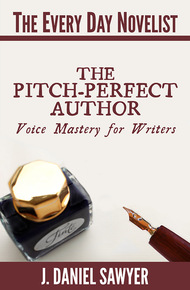
The voice commands attention. The voice arrests consciousness. The voice creates intimacy. And, within these pages, you will learn the secrets of voice that allowed authors from Shakespeare to Douglas Adams to Anne Rice build virtuosity that continue to draw readers generation after generation. Prolific author J. Daniel Sawyer shows you the secret tools you need to move from professional to virtuoso.
From accents to poetry, resonance to sensuality, learn the techniques that transform scribbles into sensation and bring the language to life.
Dan has written, produced, and marketed audio productions for the past 25 years. He's written books and short stories, run podcasts, and produced short films. The thing that unifies them all is his unique voice. – Kristine Kathryn Rusch
All of us have unique voices. Most of us don't know how to tap them. In The Pitch-Perfect Author, Dan explores voice and helps even the most reluctant writer to find theirs. – Kristine Kathryn Rusch
Introduction: What is Voice?
"J. Daniel Sawyer has the most amazing voice of any writer I've ever encountered."
—Kristine Kathryn Rusch
Of all the reviews I've ever received, that is hands-down my favorite—not just because it's high praise coming from a multiple Hugo/Nebula/Edgar/etc. award-winning writer and editor, but because voice is the thing that made me fall in love with the written word, and it's something I've made a study of all my life.
How can a pile of written words exhibit a "voice"? And what, for that matter, is an artistic voice in the first place?
Imagine you're sitting in your living room and you hear a voice call from the other side of the living room door. Without thinking about it, you know who it is—or you know that the person calling is a stranger to you.
You'd have a similar experience if you'd heard music through the door. If it was familiar to you, you'd recognize it immediately—even it it was only vaguely familiar, you'd feel that tickling in the back of your head.
But what if it was a new-to-you piece by an artist, composer, or band you knew well?
The chances are very good that, long before the vocalist (if there is one) chimed into the mix, you'd already have a pretty good suspicion of who the artist was.
Why is it that a violin enthusiast can hear the difference between Yo Yo Ma and Itzach Perlman?
How is it that a classical music fan can tell which orchestra is playing this recording of Rhapsody in Blue vs. that one?
Why does Jimmy Page's guitar work sound different from Jimmi Hendrix, and his different from John Lee Hooker's?
If your musical ear can hear the difference between one musician and another, then you know how to spot an artist's "voice" with your ear. Every other sort of art has a parallel phenomenon. For painters, it comes through in the use of paints, colors, perspectives, and brush strokes. For sculptors, it's the medium, the subject matter (and its treatment), and the detail work.
For writers, it's the way they use language.
The raw material of an artist's voice emerges from the depths of personal history. It bubbles up from the subconscious, is shaped and molded by early experience (including and especially an infant's pre-verbal experience). It's further flavored by the books you read, the friends you make, the movies you see, and the music you listen to. It's both psychological and neurological, auditory and linguistic, sensual and technical. Your voice comes through your mouth in the way you speak—and, by the time you reach adulthood, it's well-defined enough to be as unique as a fingerprint (even if it is very similar to those you grew up around).
But when you start writing, something strange happens. If you're like most writers, your writer's voice started out sounding...generic. Some part of you, feeling insecure about your ability to express complex thoughts and feelings in this new medium, reverts to the sort of writing that you think will be well-received; the sort that your teachers might have graded well, the sort that would go over well in a Reddit post, the sort that would grab the attention of a job recruiter—whatever it is, you're writing for an audience that doesn't exist on the other side of the page.
This is why so many young American fantasy writers try desperately to reproduce the feel of Tolkien's prose, often to laughable effect (I do not except my first—and thankfully unpublished—novel from this diagnosis).
This is in addition to any inhibitions you might have in writing about subjects, or with words, that your upbringing and/or education may have induced you to internalize taboos about. Race, sex, politics, gender, slurs, profanity, eugenics, intelligence, religion, violence, suicide, psychosis, neurosis, disability, social class—if there's an emotional or social charge around it, then someone has a taboo about it, and you might have internalized it (this can be an obstacle if you're writing commercial fiction, as so much of "commercial" hinges on exciting and provoking emotional responses in the audience).
These internalized taboos, combined with the internalized instinct to perform for an invisible audience, generally team up early in your writing career to make your voice far more flat and generic than it would be if you were just sitting around in a bar or a coffee shop and shooting the breeze with your buddies.
The first stretch of a writer's career is the time when the writer "finds" their own voice. For most writers, this process is unconscious—they can no more superintend it than they can honestly hear what their own vocal stylings sound like. When you live with a voice—whether it's the one produced by your throat or the one that runs the internal monologue in your head—it sounds innocuous and transparent to you, because, no matter how idiosyncratic it sounds to the rest of us, to you it's ordinary.
But by the time you get to the point where you're writing almost as fast as you're thinking the words, and you're not second-guessing how they're coming out? And when, and no matter whether you love it or hate it, it "sounds" right to you? At that point you've found your "pub voice"—that way of writing that is as basically and uniquely yours as your speaking voice is.
The next stage is more deliberate. A violinist who has mastered his fingerings and can sight-read music and reproduce it reliably is not a master violinist, she is simply competent to play in a high-school orchestra. A master violinist can take a classical piece of music and, while playing it accurately and well, transmute it into something utterly unique through the use of syncopation, pitch bending, articulation, tonal manipulation, and other microscopic technique adjustments. This is a set of technical tricks and tweaks—tools that are mostly learned rather than instinctual—that the violinist, through practice, internalizes to extend her ability to play the audience rather than the tune. At the same time, the master-in-training periodically raises internalized tools to a conscious level to refine and explore them.
This process is what moves a performer from "competence" to "mastery" and gives them a shot at being a world-class artist. And it is exactly analogous to what a writer can do to expand her mastery of voice, and in so doing move from that spot on the reader's shelf for those writers who are "good enough to buy and enjoy" to that treasured location where they keep the books they want to pass on to their grandchildren.
Writers who master voice at this level are often "voicey" writers. The way that they turn a phrase is, itself, immortal. American and English literature are both ruled by such masters of voice: Twain, Parker, Brackett, Chandler, Wilde, Shakespeare, Adams, Sayers (I could go on for several pages, but you get the point). These are the writers who were both bestsellers in their day and immortal in their legacy. The former is great for paying the rent—the latter is wonderful for feeling like a life before the keyboard was worthwhile—but, in the end, both depend on more than a bit of luck. The best you can do is load the dice in your favor.
This, therefore, is a book for those writers who are looking to develop their voice in the way that a master musician develops his chops. Throughout the following chapters, I will be introducing you to the mechanics of language that, for most people, lie just below the level of conscious perception. By the time we're done, you'll know everything that I—through my 40+ years of studying and working with language (which includes writing essays, technical articles, songs, screenplays, poems, narrative nonfiction, news stories, radio plays, novels, short stories, and advertising copy as well as many long years directing and performing in radio productions, audiobooks, theater, and independent films)—have learned about how language works. From tools that let you control pace and tone, to verisimilitude breakers and characterization tells, to rhetorical techniques and neurological hacks, you will walk away knowing how to find the levers of language that move the mirrors in the minds of your readers, so that they will feel what you want them to feel, think what you want them to think, and have epiphanies only when you're ready for them to see the light.