Mark Leslie Lefebvre has worked in the book industry since 1992 in almost every type of brick and mortar, online, and digital bookstore. He is a past President of the Canadian Booksellers Association, former Director of Self-Publishing and Author Relations for Rakuten Kobo, and the founder of Kobo Writing Life, Kobo's free direct publishing platform. He has given talks about the business of writing and publishing across North America and in Europe. Mark consults for Draft2Digital as Director of Business Development where he works on collaborations between the world's leading distributor of indie author titles and their retail and other industry partners.
With over thirty years of experience in bookselling and as an author who has embraced both traditional and indie-publishing opportunities, Mark is an advocate for helping authors understand the options available to them for finding success on their own unique author journey.
The Truth About Building a Writing Career—No Sugarcoating, Just
Real Talk. The Honest, practical guide every writer needs.
What if the real secret to a lasting writing career isn't luck or raw talent, but learning to thrive in the mess?
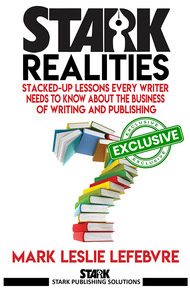
In Stark Realities, Mark Leslie Lefebvre draws on three decades as a bookseller, author, and publishing insider to offer writers a candid, compassionate roadmap through the creative wilderness. You'll find stories from the trenches—like negotiating a dozen contract changes or selling thousands of copies of a niche trivia book—plus hard-won lessons on imposter syndrome, building sustainable habits, and treating your writing like a business.
Lefebvre doesn't shy away from the tough stuff: he breaks down the realities of contracts, intellectual property, and the economics of author events, always with a focus on what truly matters—passion, persistence, and genuine connection.
Ready to build a writing life on your own terms? Get your copy of Stark Realities and let an experienced mentor guide you through the ups and downs. Don't wait—start thriving in your writing career today!
When Mark first told me about Stark Realities, it was as if he was reading my mind. Because the book is about surviving the mess that is publishing—and, by extension, surviving the world we all find ourselves in. Mark knows what he's talking about. He's worked in every aspect of publishing (except maybe agenting) and has weathered the transition from the heyday of traditional publishing to the rise of indie. This book distills thirty years of experience into a treatise on how to survive the tough times. – Kristine Kathryn Rusch
"I appreciate your brutal honesty and the stories you use to demonstrate what you're saying."
– Ruth’s Story Bytes (Substack)"Well done. There's so much help in your reflection and not falling prey to chasing the desires of others is more important than ever."
– Joe Solari, Founder of Author Nation (Substack)"This is a luminous article. Inspired. Every word is vital. What you say is true, like "The story you're telling right now, today, in that quiet room where you sit with no audience—that matters. Not because someone might eventually read it. But because you're making something that didn't exist before." You have no idea how timely it is for me to read this. Thank you, Mark, with much gratitude."
– Regina Clarke (Substack)CHAPTER 3: You Don't Need Permission
On Passion, Authenticity, and Writing from the Nichest of Niches
"Writing with passion might be the only guarantee a writer ever gets."
I need to tell you something that might be difficult to hear, and I need to tell it to you early in this book so that everything else we discuss together sits on an honest foundation.
In the 2022 Department of Justice antitrust trial that successfully blocked Penguin Random House's acquisition of Simon & Schuster, something remarkable happened. For the first time, the inner workings of the traditional publishing business were laid bare in a public courtroom, and the data that emerged was sobering. Based on roughly 58,000 titles, 90 percent of them had sold fewer than 2,000 copies. And half—fully half—had sold fewer than a dozen.
A dozen copies. Think about that. You could fit the entire readership of a typical book into the large-sized elevator in one of the tall buildings in New York City where the largest publishing companies operate.
When analysts at Nielsen BookScan followed up with a much larger dataset of approximately 487,000 frontlist titles published in a single year, the picture wasn't much brighter. Roughly half sold fewer than 1,000 copies. For just under 15 percent, it was still fewer than twelve.
The self-publishing world, to the extent we can measure it—and measuring it is genuinely difficult because the largest retailer in the space refuses to share its data with the industry—tells a similar story. Some surveys suggest the average self-published book sells around 250 copies and the average indie author earns about a thousand dollars a year. But even those averages are misleading. From my years at Kobo and Draft2Digital, I know firsthand that a small number of high-earning authors with five-, six-, and seven-figure incomes pull those averages dramatically upward. The reality for most self-published books is that they'd be fortunate to sell more than a handful of copies or earn their author more than a hundred dollars.
I'm not sharing these numbers to discourage you. And I'm certainly not sharing them to look down on anyone. I share them because I believe writers deserve to understand the landscape they're operating in, and too many voices in this industry are either ignorant of these realities or actively invested in hiding them from you. If someone is selling you a course or a system or a magic-bullet strategy and they haven't acknowledged these numbers, they are not telling you the whole truth.
So here's the question these numbers force us to confront: if the odds of commercial success are this stacked against most books, why would anyone write one?
I've thought about that question for a very long time, and I've arrived at what I think is the only honest answer.
You write because you love it. You write because the act of writing—the actual process of wrestling an idea into words and shaping those words into something that exists outside your own head—is inherently rewarding. You write because the story matters to you, because the subject fascinates you, because the creative challenge of making it work lights something up in your brain that nothing else quite reaches.
And that, based on the stark and sometimes brutal mathematics of publishing, might be the only guarantee a writer ever gets: the guarantee that you invested your time in something you genuinely enjoyed doing.
I know that sounds like small comfort when you're spending months or years on a manuscript. But I want you to sit with it for a moment, because I think it's actually the most liberating idea in this entire book. If the only thing you can control is whether you enjoy the work, then the single most strategic decision you can make as a writer is to write the things you're passionate about. Not the things the market tells you to write. Not the things a guru says are trending. Not the things you think will sell. The things that make you lose track of time, that keep you up at night with possibilities, that make you feel alive when you're working on them.
Because if the book doesn't sell—and statistically, it probably won't sell in enormous numbers—you still got to spend all that time doing something you loved. And if it does sell? Then you've got an audience who found you precisely because you were doing something authentic, something that came from a genuine place, something that no other writer on the planet could have produced in exactly the way you produced it.
Let me tell you about the nichest of niches.
I've been a fan of the John Hughes movie Planes, Trains and Automobiles since I was a teenager. I've watched it at least once a year, often twice, every single year since it came out in 1987. It's a film I know inside and out—not just the dialogue and the performances, but the behind-the-scenes details, the shooting locations, the production history. It's one of those passions that lives so deep in me that I never thought to question it or justify it. I just loved the movie, and I loved knowing everything about it.
One of the small details that always fascinated me was the book that John Candy's character, Del Griffith, is reading when he first meets Steve Martin's Neal Page at LaGuardia Airport. The shooting script describes it as a pornographic novel, and the prop department used an actual adult paperback published in the early 1980s called The Canadian Mounted—an obvious and cheeky nod to the fact that Candy was Canadian. Years later, when I spotted what appeared to be the same book in a brief scene in one of the Deadpool films—Ryan Reynolds being a well-known Candy fan—I fell down a research rabbit hole that would eventually become a book of my own.
I created a trivia guide about the film, designed to look as close to the original prop book as possible. Same page count, same cover dimensions, same basic layout, but filled with behind-the-scenes details and film trivia instead of the, uh, original "active romance" content. I crafted the cover to be a subtle parody, swapping the publisher's logo for my own, adjusting the back-cover copy to explain the tribute rather than advertise the original's more explicit offerings.
I figured there might be twenty or thirty people in the world who were as obsessed with this detail as I was. Maybe a few dozen fellow nerds who would notice the book, understand the reference, and appreciate the effort.
To date, that book has sold just under 10,000 copies. Ninety-eight percent of them in paperback.
Now here's the part that matters more than the sales number: before I sold a single copy, I already felt successful. The process of researching and writing that book—digging into production records, studying the shooting script, tracking down the history of the original prop—was one of the most purely enjoyable creative experiences of my career. It was a hundred percent passion project, and when I finished it, I felt a deep, genuine satisfaction that had nothing to do with the marketplace. I had done a thing that mattered to me, and I had done it well, and that was enough.
The sales were gravy. Delicious, surprising, affirming gravy. But they were gravy.
I want to pause here and issue a caveat, because the publishing world is full of authors who share their success stories and then say, explicitly or implicitly, "I did it, and so can you."
That's not what I'm saying.
I've tracked and consulted with thousands of authors over the years, and I've watched what happens when a hundred writers all do the right things the right way—write a strong book, invest in professional editing and cover design, position it carefully for the right audience. And the truth is that for some of those writers, the magic bullet fires. The algorithm picks them up, or word of mouth catches, or some unpredictable cultural moment makes their book the right book at the right time.
But for most of them, it doesn't. Not because they did anything wrong. Not because their book wasn't good enough. But because the one variable no author can control, no matter how smart or hardworking they are, is luck.
The harder you work, the more chances you create for luck to find you. That's true. But it's not a guarantee, and anyone who tells you otherwise is selling something. My niche trivia book about a movie prop could easily have sold ten copies instead of ten thousand. The work would have been just as enjoyable. The creative satisfaction would have been just as real. The only difference would have been the size of the audience, and that was never in my control to begin with.
This is exactly why passion matters so much. It's the one variable you do control. You can't control the algorithm, the market, the timing, the luck. But you can control whether you spent your creative hours doing something that felt meaningful to you. And when the math doesn't work out—and for most books, most of the time, it won't—having invested that time in a passion project is the difference between regret and contentment.
Passion is closely linked to something else that I think is undervalued in the advice most writers receive: authenticity.
For years, I was stressed out about my author brand. The conventional wisdom in publishing is that you should have a clear, consistent identity so that readers always know what they're getting. And I understood the logic of that. The problem was that I'm not a single-genre, single-identity kind of person. I write horror, true ghost stories, urban fantasy, thrillers, and nonfiction books about the publishing industry. I'm also a craft beer enthusiast, a dad-joke machine, a lifelong Spider-Man fan, and a collector of skulls and skeleton paraphernalia. When interviewers would reach out, I'd need to know which version of me they were expecting so I could wear the right hat.
That's exhausting. And worse, it's dishonest. Not intentionally dishonest—I wasn't lying to anyone—but dishonest in the sense that I was constantly editing myself, hiding parts of who I am to present a more marketable version. During author consultations, I'd think about whether I should move the skulls off the bookshelves behind me because I was supposed to be a "business professional." I'd put on a sports coat, but underneath it I'd still be wearing a skull T-shirt, and somehow that felt like a contradiction I had to manage rather than a truth I could embrace.
Eventually, I stopped managing it. I stopped trying to hide the complexity of who I am. I stopped apologizing for the skulls on the shelves and the dad jokes in my presentations and the fact that my interests span half a dozen genres and a lifetime's worth of eclectic obsessions.
I arrived at a simple philosophy: Here I am. This is me. Love it or leave it.
And something remarkable happened. People didn't leave. They leaned in. Almost every day now, someone tags me on social media with a skeleton meme, a horror joke, a craft beer recommendation, a dad joke that made them think of me. They saw something and their first thought was that I'd appreciate it. That's not a branding failure. That's a human connection. That's someone saying, "I know who you are, and I like who you are, and here's something that reminded me of you." You can't buy that with a consistent color palette and a three-word tagline.
I'm not naïve about the tension between passion and market awareness. This is a business book, and I'm not going to pretend that the marketplace doesn't matter. If you want to earn a living from your writing—or even supplement your income meaningfully—you need to understand your audience, your genre conventions, and the channels through which readers find books. I've written extensively about that in my other books, and we'll touch on some of it later in this one.
But here's what I've observed over thirty-plus years in this industry, from every conceivable vantage point: the writers who build the most durable careers are not the ones who chase every trend. They're the ones who find the intersection between what they love and what an audience wants, and they stay in that intersection long enough for the audience to find them.
The distinction matters. Chasing trends means abandoning your work in progress every time a new subgenre gets hot. It means writing vampire romance because it's selling, then pivoting to dark fantasy, then to cozy mystery, then to romantasy, always one step behind the curve and never building a body of work that coheres around a recognizable voice. The writers who do this are channels, not artists, and when the trend moves on, they have nothing left. No backlist that builds on itself. No loyal readers who came for them, specifically. Just a scattershot bibliography and the exhaustion of having spent years writing books they didn't particularly care about.
Writing from passion is different. It means knowing your interests deeply enough to write about them with authority and enthusiasm. It means trusting that if something fascinates you, there's a reasonable chance it will fascinate other people too—maybe not millions of people, but enough. It means building a body of work that reflects who you actually are, so that when readers find one of your books and love it, they can follow a thread to ten more that scratch the same itch.
That's a career. The other thing is a hustle. Hustles burn out. Careers endure.
I want to tell you about an author named Ron Vitale, because his story captures something essential about what I'm trying to say in this chapter. I interviewed him on Episode 397 of my Stark Reflections podcast.
Ron has been writing and publishing since 2011. He openly shares that he's had good years and bad years, and that in 2024, he earned $1,065 from his writing and spent $1,306. He lost money. And yet, he's still writing.
There are people who would look at Ron's numbers and call him a failure. Those people are wrong. Ron is a writer who has spent more than a decade doing something he loves, learning his craft, putting books into the world, and building a body of work that represents who he is as a creative person. The fact that his revenue hasn't consistently exceeded his expenses doesn't negate any of that. It just means the math hasn't caught up yet—and it might not, because the math doesn't catch up for most writers, and that's not a personal failing. It's the landscape.
I worry about writers like Ron giving up. Not because I think everyone should keep doing something that makes them miserable—if writing is making you miserable, that's a different conversation, and we'll have it later in this book. But because I've seen too many talented, passionate writers look at the six- and seven-figure income screenshots that dominate social media and conclude that they must be doing something wrong. They're not doing anything wrong. They're doing the most right thing a person can do: creating something meaningful in a world that desperately needs it.
The world needs Ron's books. It needs your books. It needs the weird, the niche, the deeply personal, the passionately crafted, the books that only you could write because only you have your particular combination of obsessions, experiences, fears, and joys.
The odds are against you, and you should write anyway. Not in spite of the odds, but because of what writing gives you regardless of the odds. The intrinsic reward of the work itself. The satisfaction of crafting something real. The joy of spending your creative hours on the things that matter most to you, surrounded by the subjects and stories and characters that make you feel most alive.
You don't need permission to write what you love. You don't need a market study that validates your interests or an algorithm that confirms your genre choice. You don't need anyone's approval to pursue the nichest of niches. The writer who creates something authentic and passionate has already won the only contest that's fully within their control.
And if you're lucky—and you might be, because luck does find people who are doing genuine, passionate work—the audience will follow. Not because you chased them, but because you were standing still, doing the thing you were made to do, and they recognized something real in it.
That recognition? It's worth more than any algorithm. And it starts with giving yourself permission to be exactly who you are, on the page and off of it.