USA Today bestselling author Mindy Klasky learned to read when her parents shoved a book in her hands and told her she could travel anywhere in the world through stories. She never forgot that advice.

Mindy's travels took her through multiple careers. After graduating from Princeton University, Mindy considered becoming a professional stage manager or a rabbi. Ultimately, she settled on being a lawyer, working as a litigator at a large Washington firm. When she realized that lawyering kept her from writing (and dating and sleeping and otherwise living a normal life), Mindy became a librarian, managing large law firm libraries. Mindy now writes full time.

For years, Mindy's dating life was a travel extravaganza as well. She balanced twenty-eight first dates in one year, selecting eligible gentlemen from sources as varied as Washingtonian magazine ads, Single Volunteers of D.C., and supposedly-certain recommendations from best friends. Ultimately, she swore off the dating scene entirely. After two years of carefully-enforced datelessness, she made one last foray onto Match.com, where she met her husband on her first match.

Mindy's travels have also taken her through various literary genres. In addition to her cozy paranormal romances and category romances, Mindy has written traditional fantasy novels (including the award-winning, bestselling The Glasswrights' Apprentice), short stories, and nonfiction essays. Mindy has been awarded the Career Achievement Award and the Nancy Richards-Akers Mentoring Award by the Washington Romance Writers. She has written more than sixty books.

In her spare time, Mindy quilts, knits, and tries to tame her endless to-be-read shelf. Her husband and cats do their best to fill the left-over minutes.
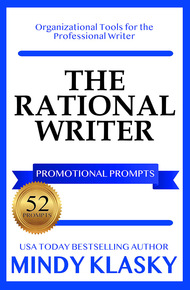

The Rational Writer: Promotional Prompts by Mindy Klasky

The Rational Writer: Promotional Prompts contains fifty-two prompts to jump-start creative thinking for authors interested in constructing a unified promotion portfolio for their books. Broad topics include Author Identity, Individual Books, Websites, Communications, Business Partners, Group Promotions, Advertising, Social Media (Old and New School), Physical Goods, and a range of Miscellaneous subjects.

CURATOR'S NOTE

Mindy Klasky has forgotten more about promotion than I ever knew. I'm so excited to read this book because I'm getting back into the promotion game, and I want to learn from one of the best. She asks the questions that will help writers figure out how to handle their own career. She doesn't tell you what to do. She helps you figure out what you want to do. – Kristine Kathryn Rusch


BOOK PREVIEW

Excerpt

Book Covers

Do you create your own book covers, or do you purchase covers? If you purchase, do you buy pre-made covers or do you pay an artist to create one specifically for you? How are your covers similar to others in your genre and sub-genre? How are they different? Do you use illustrated ("cartoon") covers or photographic ones? Do you include teaser quotes from your book or pull quotes from reviews? Does your cover prioritize your title or your author name, using fonts, font size, and/or placement? If your book has a subtitle, do you list it on the cover?

If you write in series, how are books in one series similar to each other? How are they different? Do you use a series title or logo on your cover? Do you list the book number on your cover (e.g. Book 1)?

If you publish print books and ebooks, are your covers the same for both formats? How does that similarity or difference compare to other authors in your genre and sub-genre?

For print books, what elements do you include on the back cover? If you use a blurb, is it the same one you use for other promotional purposes? Do you include your website URL and/or your publisher's website URL? If so, do you print the address or do you use a QR code? If you use a QR code, do you have any human-eye-readable content in the QR code (e.g., a book name or an image of a book cover)? Do you include a link to your newsletter magnet? If you print your books through Amazon, do you include your own bar code or do you accept Amazon's bar code? Do you include any human-eye-readable content above or below the bar code?

Do you have any cover elements that carry over to all of your books? If you write in different genres or sub-genres, how do you try to maintain similarities between them? How do you balance standing out in the crowd with matching reader expectation?