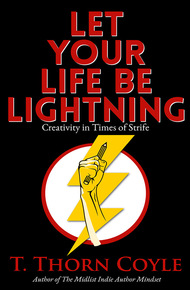
T. Thorn Coyle believes that magic is real, justice is worth fighting for, and love always wins. Their fan-favorite fantasy series include The Witches of Portland, The Steel Clan Saga, The Mouse Thief Cozy Fantasy Capers, and The Panther Chronicles. Thorn also pens two popular paranormal cozy mystery series featuring cats and corgis: Bookshop Witch, and Pride Street.
Thorn's non-fiction includes The Midlist Indie Author Mindset, You Are the Spell, and Sigil Magic for Writers, Artists & Other Creatives among several others.
Thorn takes a lot of walks in Portland, OR where they talk with crows, squirrels, cats, and trees.
Who are you to create? Who are you to write? Who are you to bring your passion to the world? Who are you to call yourself an author? A poet? A painter? A dancer? A potter? A weaver? Who are you not to?
This collection of essays offers reflections on the creative life, how to beat imposter syndrome, and how to create for the long haul, especially during tumultuous times.
Thorn is a positive voice in a world of darkness. I follow them on various social media platforms and as other people metaphorically wring their hands, Thorn posts just the right amount of content to bring a bit of light into the world. Their book, Let Your Life Be Lightning, explores how to create and survive in tumultuous times. Thorn is probably the best teacher I know for this. – Kristine Kathryn Rusch
Chapter Thirteen: Kicking Out Perfectionism
What does the word "perfect" mean to you?
How does perfectionism affect your creative process? It certainly has impacted mine.
I was raised to be a perfectionist. There were many reasons for this, including random outbursts of violence that could come at any time, always for some "reason" that never made rational sense. Plus, I was smart. And good at things. This was useful, as it meant I could get the praise I wanted easily for many things. For the things that were harder? I just wouldn't do them.
As an adult, I realized how detrimental this was to my life. I had to learn how to learn. And that was difficult, because part of learning is not doing things well. We learn through practice. Through experimentation. And if we want things to be perfect? Well, experimentation and practice can feel brutal because we feel as if we're failing all the time.
So, even though I tried to commit myself to learning, I still wanted perfection and was hard on myself when I fell short. And this time, the blows came from inside me instead of outside.
One small event began to turn this around.
I used to be a semiprofessional dancer. After what I thought was a terrible performance one night—I was so angry with myself about it, I felt ready to kick a wall—someone came up to me to gush and tell me how wonderful the dancing had been. They had loved it. Throttling down my anger, I forced myself to stand and smile and finally said two words: "Thank you."
In that moment, I glimpsed how disrespectful it was to that person's experience to offer any other words than those of thanks. It took me longer to realize how disrespectful I was being to myself and to my own creative process. My over-the-top response was based in childhood fear and trauma, though I did not recognize it at that time.
But in that moment? Perfectionism was trying to seize control. And it was ruining my life.
Perfectionism almost ruined writing for me. I've written since age five. Writing was one thing I got rewarded for in school. I would write poems and essays with little effort, enjoying the flow of words.
That said, in my twenties, I went through a period where I labored for one year on a single short story, only to have it rejected. I labored over novels, getting stuck half or two-thirds through. Rather than getting interested at that point, I would grow frustrated and abandon them.
Throughout this time, I was still writing poems and getting them published. I was dashing off articles and interviews and getting paid for them.
Finally, I decided, it was fiction that was the problem. I was just no good at it. I'd decided the same thing about acting, many years before, abandoning the love of my youth.
So, I put my attempts at fiction to the side and focused on non-fiction instead. I sold non-fiction books to traditional publishers and wrote essays for my blog. I also traveled the world and taught instead. This was all great, but deep inside, a part of me always hoped I might get back to telling stories one day.
Years passed, and I finally gave that hope up as nothing more than a fantasy, because clearly, I wasn't doing anything about it.
Then, one day, I was sitting in my living room, staring out at the sunlight reflected on the leaves of a giant elm. A thought popped into my head: "I hate those leaves."
This shocked me. I loved looking at the leaves. So, whose thought was this? It turned out it was a character named Jonah, whose best friend, Alex, had just been killed.
Of its own volition—or via the strength of my subconscious—fiction came back to me. Consequently, I had to learn how to treat fiction with respect, just as I'd learned to respect myself over the years. But harder than that? I had to learn to hold it lightly.
Over time, with study and practice, I learned what I call the technique of "write and release." This means I write the story that wants or needs to be written and—whether or not I think it's any good—I send it out into the world.
If my brain locked up, or I wanted to figure out what the right direction was? I took a breath, dropped back into the character's point of view, and I wrote the next sentence. And then the sentence after that.
Now, this process was relatively easy for me with non-fiction, but I know non-fiction writers who have the same issue. If this is you, try it. Take a breath. Release your attachment to what's right and drop back into your topic. Write the next sentence. And then the sentence after that. Or draw something, anything. Or challenge yourself to sing in a new style. Or… In other words, you can adapt this to any art or craft.
These practices all help me to continuously kick out perfectionism. My stories don't need to be the perfect story; they need to be the stories they are. There's a character with a problem, in some office building, or space station, or fantasy village somewhere. I want to know what that place is like, and more importantly, how the character deals with that problem. So, I write. And then I release.
With practice, this has become easy. I hold my writing lightly now. Every story and novel is not a precious jewel. They're just stories. And some people enjoy the heck out of reading them.
They even give me money for them. And they tell their friends.
There are many more ways to kick out perfection than I have space for in this essay. I'll deal with some of these in the next piece. But for now, we can re-commit, and show up to practice, day after day.
Most of all, we can learn to trust our inner voice. We can choose to listen to our creative drive more often than we listen to our fears.