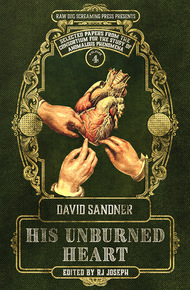
Dr. David Sandner is a member of the HWA and SFWA. His recent work includes The Afterlife of Frankenstein (2023) in Lanternfish's Clockwork Editions and novellas His Unburned Heart (2024) from Award-winning horror press Raw Dog Screaming as well as Mingus Fingers (2019) and Hellhounds (2022) from Fairwood Press, co-written with Jacob Weisman. Sandner is the author of The Fantastic Sublime and Critical Discoursers of the Fantastic, 1712-1831 and editor of The Treasury of the Fantastic and Fantastic Literature: A Critical Reader. He is a Professor of English at California State University, Fullerton.
His Unburned Heart tells the story of Mary Shelley's quest to retrieve her husband's heart from his publisher. History tells us that Percy Shelley was cremated, though his heart failed to burn, but the rest of the details are lost to time. Sandner has channeled Mary Shelley herself to share the story with us. That story is paired here with a second, related, piece. The Journal of Sorrow is named after Mary Shelley's personal journal, and imagines Percy Shelley's demise.
"Sandner presents a tender examination on the nature of grief as a literary icon speculates on her lover's demise and the strange effort to recover the last physical remnant of her dead poet. Compelling and very moving prose."
– Tim McGregor, author of Wasps in the Ice Cream and Eynhallow"Sandner has crafted a terrific tribute, capturing the voice of not only young Mary but the whole period in which she lived, artfully winking with references to the literary history of the time, all while building on the sublime and terrifying concepts that underpin this artful tale. Only a writer, theorist and researcher like David Sandner could pull this conceit off so well, balancing tribute with tension, and Frankenstein's many fans and literary scholars alike will find this treatment a fascinating contribution to the legacy of Mary and her hideous progeny."
– Michael Arnzen, Bram Stoker Award winning author of Grave Markings and 100 Jolts"This novella has not only some of the best writing I have read in quite awhile, but is some of the most powerful writing I have read. Sandner uses words like a painter setting scenes, drawing emotions, and capturing the era… A really amazing work, one I didn't want to end, but understand why it had to."
– Dan O’Leary, NetGalley16 August 1822, Tuscany
Shelley's body on the pyre smoked, ruptured. Winding light round shadows, the fire moved and snapped and cracked—bright, shivering, shifting, glistening, spitting. Flames flared—yellow, pale green, numinous white, terrifyingly empty. Respiring in the wind off the sea, the fire heaved, staggered, loomed up, intolerable—laughing sharply, coughing smoke into a cerulean sky; the fire reached out to kiss our faces wet with sweat—as if we were its children. But we were nothing before that fire. My husband's funeral pyre on a beach near Viareggio.
Even before the burning, his body had been ruined: corrupted, half-eaten by the sea, with clothes tattered and once-flowing hair sparse and dun. Even before he was placed on the funeral pyre atop Trelawny's makeshift iron oven, the dried skin of his corpse had hung loose like an ill-fitting shift, patches sagging or furrowing as the Tuscan soldiers lifted the body from its shallow temporary grave of lime and sand on the narrow beach. When it burned, the skin along the face and legs, brittled by lime, blackened and cracked like parchment from an old book left unread for an age—a book of blasphemies to be put to the torch at last. The flames should have absolved us all—exchanging inevitable decay for nothing, releasing us, but, something would not give—
I felt I would choke but not from smoke—
His heart, unrecked, would not—
The fire keened in the wind. It barked, roared, whistled, inhabited by some daemon come to honor our dead prophet. When the body had burst into flame, it held shape still for a time, accepting the flames entwining it like a mummy. Until the burning cracked the bones, allowing the fire to worm in, greedily, and then the inner matter—already unintelligible as organs or muscle—bubbled thickly— sickeningly. And then—what then?
Unbearably, his heart would not—
At last, where there should have been only charred bone, nothing more, some…unknowable remained—more like an ideal thing from his dreams or poetry—as insistent as a conscience. There, in the revealed cavity of his cracked chest, lay his absurd heart: a dark lump, smoking.
Unaccountably, his heart—
Laid bare on blinding white sand before endless blue on a beach in Viareggio, his heart, immutable—
Shelley's heart would not burn.
There, in the charred lump of his unburned heart, in its impossibility, my story lies. If you will know it, you must know it with the unsayable left in; the excess, like his heart, abides.
Trelawny knelt close to the fire, closer even then Byron; shirtless, dripping sweat from his arms and off his thick beard, he raised his muscled arms in supplication. Shaking, wild-eyed, he seemed to want to throw himself into the flames. It was he who had insisted on burning the corpse. Reckless, high-spirited, a sailor and adventurer, Byron had christened him "my corsair" after the pirate hero of his poem—and Trelawny embraced the designation. He would, if he could lie enough and strive enough to live his life so. He had performed invented rites to honor the dead poet. He had poured wine and oils on the corpse, and on himself, and danced and recited ancient poetry to the sun.
Byron, in a tight black coat and breeches, remained close in, unmoving, burning coal eyes gazing into the inferno as if he had turned into a pillar of salt; the light hollowed his cheeks in his skull as he pursed in concentration.
A baker's dozen ill-attired Italian soldiers, a local militia, their white shirts soiled and untucked under indifferent brown longcoats, with overlarge hats scuffed and cocked hurry-scurry, moved away, murmuring, breaking what little discipline they had, milling nervously, turning their backs, crossing themselves.
"The smell, the heat," they called to each other in Italian; "the smoke," they said coughing, "the devil's light!—the crazy English!"
Their captain, his suit, though worn, in good discipline, looked pointedly out to sea at nothing. Nothing to notice, those were his unspoken orders: stand and endure.
In jealousy or frenzy at those who remained, the fire shot up astonishingly high and bright, intensifying, sparking, crackling, humming in the wind. The shimmering light hurt our witness eyes. Pulsing yellow in billowing white in flaring red, haloed in an orange luminescence, the fire cast our shadows on the sunlit beach. What is it we burned? What was my Shelley? With that fiery show, all stood dumb before the weird blaze, our bodies painted lurid colors, our faces changed for stranger's faces. Byron had endured the rituals with aplomb, somber at the circumstances but mildly amused at the worked up fervor of our self-appointed pagan priest Trelawney. The strange fire rising up cast his mood into deep shadow.
Leigh Hunt, the poet and publisher, and our friend, had come with Byron by the road—a dirt cartpath just off the narrow ribbon of sand before the sea. To the South lay Lerici, where my Shelley and I had lived at lonely Casa Magni, our boathouse hanging above the waves; to the North bustled Leghorn, which the Italians called Livorno, where Hunt had arrived from England and Shelley had sailed to greet him. Here, this beach…it was nowhere—a lost place (his last place) between here and there.
Hunt retreated from the heat, sagging in an attitude of grief against Byron's great black coach. A fancy script "LB" was inlaid in gold on the door that he opened. I stood behind the coach, though he did not note me as he stepped inside. For I was not there—I was in disguise; I had been disbarred from attending for I was only a woman (only Shelley's wife); I stood beside Tita, Byron's hulking manservant, who only frowned and bowed his head at all that transpired. Aside from the Italian militia, there were a half-dozen men manning Byron's boat, the Bolivar, rocking gently on the sea, close to shore. The boat had brought Trelawny and his iron oven for the pyre. The crew had lined the deck, holding absently to the rigging or leaning on the boat's edge, paying respect to the dead. Until the fire had brought wildness—frightening and terrible—to us all.
All marveled, but then averted their gazes from the heat. Their eyes became dulled to sublimity—who can look into its cracked-mirror gaze for long? Soon the Italians and Byron's sailors talked amongst themselves and paid no heed, waiting for the odd English nobles to finish their rites, waiting for normalcy to restore all illusions.
All had turned away, disturbed, afraid, except Trelawny, swaying, nostrils flared, wide-eyed, and Byron, unwilling to be moved by any power, any strangeness, wrapped in thoughts of fire to match the blaze before him. And me.
Then Trelawny saw the heart. His charlatan show over, no one watched him now. His display of pagan pomp served as a perfect distraction. Having been the center of attention, none watched him now, slightly embarrassed for him in his foolishness, slightly afraid of his audacity. Looking about himself first to see if any of the local militia watched, Trelawny snatched the heart out of his friend's cracked chest.
And no one else, not even Byron, saw—no one else but me: we two alone.
If the militia had seen him, he would have been quarantined, at least; what he had snatched out would have been quickly taken away. But then—what then? An unburned heart? What would they have done with it? Sailed it out to the deeps of the sea and thrown it in, fearful of contagion? Perhaps my Shelley's heart should be treated so—they would be right to fear it—for was it not, in its imperviousness, an indictment of us? What fragile hearts had we to judge anything?
Trelawny burned his hand badly in his rash act. He had moved quickly, but the heart itself was hard as stone, dark underneath but white with ash, smeared and crusted with hot matter—for a moment his hand smoked as it seared. Trelawny, however, mastered himself, not calling out, only stifling a keening sound that all let pass; they did not want to see anymore, or know anymore. He quickly wrapped his trembling hand in a cloth and hid the heart among his pagan appurtenances—the bottles, braziers, and incense he had brought with him to honor the dead poet.
Having snatched it from the fire, Trelawney lay my Shelley's heart, cooling, in a leather satchel. Why not? Shelley had no more need of it. One might take it as a remembrance of a loved one lost as one kept hair in a locket or took a finger bone. But this was something stranger. Why it endured was not the most important question. Instead, wonder: if Shelley left this tangible sign, who could read it? To whom did this sign, this wonder, this thing unprecedented—to whom did this unburned heart belong? If it had burned up, would we have been released from all our travails? Was his heart here to compel us to a task—what task? To give ourselves up to the fire? To abjure the flame and seek more life?
I do not know. But I ask you to remember: the heart is the reason before reason for all I relate. I would not turn away at any price from those flames. For there, in his heart, in its stubborn remainder, lie questions whose answers must be looked for inside other hearts, less impervious to flame, including my own.
So to my story.