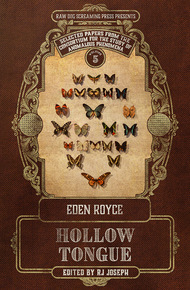
Eden Royce is a writer from Charleston, South Carolina now living in Southeast England. She's a Shirley Jackson Award winner and a Bram Stoker Award finalist for her adult fiction, which has appeared in a variety of print and online publications.
Her books for young readers have received Walter Dean Myers Award Honors, and been recognized as an Andre Norton Nebula Award Finalist, an Ignyte Award winner, a Bram Stoker Award winner, a Mythopoeic Fantasy Award winner, and a Junior Library Guild Gold Standard Selection for outstanding children's literature.
Find her on her website at edenroyce.com and on social media via her LinkTree.
Hollow Tongue has received the Shirley Jackson Award in the Novella category and was a finalist for the Bram Stoker Award
After a major accident leaves her in a dire financial situation, Maxine Forest returns to live in her childhood home. The empty husk holds only the memories of her father's abuse and her mother's reticence to leave him: her parents are nowhere to be found. The cocoon of her past remains unchanged, yet wrapped in the ghostly remnants of her mother's whispered insistence that things could change. Escaping the sins of her parents should be easy enough for Max, but those sins are intrinsic to her genetic make-up, so escape is impossible—succumbing, and metamorphosis, are inevitable.
"…equal parts beautiful and grotesque, with prose so alive it practically leaps off the page. Hauntings both familial and societal are deftly interwoven in this stylish and atmospheric Southern Gothic that feels truly contemporary—and the mystery behind safe box 236 will keep readers on the edge of their seats until the story's terrifying and shocking conclusion."
– Catherine Yu, author of Direwood"In this transformative novella, Royce deftly explores what it means to revisit childhood trauma from an adult perspective. With an arresting voice, stunning prose, and atmosphere thick enough to taste, Hollow Tongue is Southern Gothic at its finest!"
– Kelsea Yu, Shirley Jackson Award-nominated author of Bound Feet"Hollow Tongue revolutionizes the haunted house genre by embedding beating hearts into its walls. Royce balances memory, trauma, guilt, morality and immediate danger with a touch as delicate as a butterfly's wing. She has gifted us a complex, layered and thoughtful tale with a stunning ending that made me gasp. Eden truly is one of the most outstanding voices currently writing horror. Read this book!"
– Suzan Palumbo, Author of Skin Thief: Stories and CountessThey would eat us, if they could.
The man in the video Maxine is watching is small, fragile-looking, with large, wide eyes. Intense enough that her mama would have called them crazy eyes. When she was younger, she used to tell her mama not to use that word, but Mama would suck her teeth and say, "Nothin' wrong with being crazy. Crazy might save you one day."
Maxine sucks her teeth, too, remembering, while the hot crab dip she took out of the oven cools to an edible temperature on the table in her eat-in kitchen. She's treated herself to the crab meat, just enough to make a dip, not a full lump crabcake, and the fragrant dish sits waiting, while she goes to pour herself a drink. It takes longer now, to cross the kitchen with her injured leg, but she manages it this time without grunting. Jaw set, she fills a glass with iced tea.
The man in the video says the phrase in all seriousness. Briefly, she wonders if the scientist Mama used to work for looks the same. Then he smiles as an afterthought, as though someone told him in the past to soften his intensity for the comfort of others. His smile is anything but comforting, though. It's a rictus, a frozen show of bone and pink flesh that makes him look more like a grotesque puppet than the scientist the lower third says he is. In that smile, he acknowledges what he says is beyond the pale. No one wants to know that something so small and beautiful desires us for its food.
Why does the algorithm recommend this foolishness? She's never watched a video on insects before, why would she want to now? Maxine closes it, puts on her favorite oldies playlist instead. Disco, the sound she and her mother used to clean the house to, oozes through the speakers of her phone. When she returns to the table, a butterfly, purple and black and blue and yellow—what bruise colors looked like on her light brown skin—has perched in the middle of her casserole dish. The sliding door onto the balcony of her apartment is open to late afternoon, the warm from the oven dish enough to lure the creature in to feed.
It perches prettily on the crisp-topped crab spread like a living garnish, its bruised-flesh wings batting in delight as it sucks up the moisture from the last meal she will ever buy with her salary from the packaging company. They've laid her off after seven months, and while it may have had to do with her inability to crouch and bend the way she used to, surely there was something she could have done to stay employed.
But the pro-bono attorney she'd spoken to doesn't think so. A condition of her employment was being able to lift 30 pounds and she could no longer fulfill that requirement. Be thankful for such a generous severance package, he'd said as he gathered his paperwork, in a hurry to get to his next chance to deliver bad news.
By the time she'd managed to push back from her table, and lever herself to a standing position, he was at the door turning the knob. It didn't move and she made her way across the living room with pain-filled glee, watching his distress at seeing her unbalanced movements. He pulled on the deadbolt lock and key again in an effort to leave.
Her pleasure then turned to irritation. He couldn't wait to get out of her home. It was a small apartment, all she could afford in D.C., where the rents were high and the possibility of her saving enough for a down payment for a home was the equivalent of finding a unicorn to lie in her lap. She bit her lip against the ache. And it was just a limp, for God's sake. Honestly, it was more of a stiff-legged shuffle, rock to the side, lift and thrust to her gait. Maxine let out a dark chuckle. Described like that, her walk sounded like the steps to a line dance. Tariq might have still loved her then, as he loved any dance he had to spend time mastering. Not so much with women.
She'd met the attorney at the door and ignored his shrinking back to give her room. "There's a trick to getting it open." She'd twisted the key in the lock and the doorknob at the same time, in different directions and with a squeak the door swung open. Crisp air flooded the house, sending a chill through her. The attorney had been halfway down the stairs before he'd thrown back over his shoulder that she could call him if anything else came up.
Yeah, right.
She comes back to the present in a rush, like the jolt when someone slams on the brakes, the seatbelt yanking your body back from certain mutilation. For a moment, she watches the intruder. This food thief, she is stunned at its audacity. She considers filming the phenomenon, but quick movements are alien to her now. Instead, she tries to shoo it away with the mail she'd retrieved earlier, but the butterfly is reluctant to leave its prize. Only when she tries to pick it up in cupped palms does it finally, drunkenly depart the way it had come.
Maxine pats the sweat from her brow. Having to rush over to remove the intruder, even that small movement irritates her leg. She smoothes the wayward puff of her hair back from her face with one hand and leans against the counter to catch her breath. She fans herself with the mail, ready to toss once she's cooler, until her own name printed on one envelope catches her eye. Junk mail, flyers, and solicitations to the "Current Occupant" are the only physical mail she receives. More confused than concerned, she plucks a paring knife out of the block near the stove and plops her weight down in a chair. The return address is printed on an inexpensive white business-sized envelope in blue ink:
TruNational Bank
P.O. Box 124486
Charleston, SC 29403
A missive from home, then.
Although she's been away for years, Maxine considers The Chuck to be home. No matter how much it had hurt her, or how long she spent living in D.C., Chucktown has wormed its way into her core. Mama or Daddy sending a letter is a thin hope anyway; they believe it's her duty to check on them. She's their only child, eternally a child in their eyes even though she is twenty-five. Maxine has only reached out a few times in those years; no reason for a change now.
She slips the knife between the folds of the envelope and rends it open, leaving a trail of whitened dust on the air. She reads the contents, one sheet of standard paper laser printed with the bank's letterhead and signed by the branch manager, whose name she doesn't recognize. Informing her that if payment for the safe deposit box listed with her and her mother's names was not received within ten days of the letter's date, the box would be drilled open, the contents emptied, logged, then turned over to the state as abandoned property. So, seven years have passed since she left. If this letter has found her, Maxine knows that means Mama got out.
After returning the letter to the envelope, she takes slow, even breaths to calm her speeding heart. The scent of the crab spread clouds the room. She ignores it, and the pain in her leg when she rocks the stool back on its legs and gets up, hobbling around her efficiency kitchen. Maxine wants to laugh, but she is too stunned to be thrilled. She wonders how Daddy is taking Mama's absence and if he is sorry yet. A prickle of hurt needles through her heart.
Why hasn't Mama tried to call or email? Had she just run for the hills and everyone else be damned? Maxine's read somewhere once that trauma makes you cruel. Or is it terror? Both apply, and to both her and Mama. She can't begrudge her mother anything she decides to do to celebrate her freedom. Maxine's been able to leave because Mama had made a way for her to; there is no telling what Daddy had done when she wasn't there to share in the duty of dispelling his anger. She should be glad Mama's finally out of that house.
Mama's out. Mama's out. She does her rocking, walking dance to the beat of those words. Mama's out. Mama's out. Either that or she's dead. No matter what, Maxine now had to go home to see which was true. And to clear out the contents of that safe deposit box.
If Max is honest with herself, she doesn't remember what's in the box, but she remembers her promise to clean it out if anything happens to her mother. Impossible to let anything of her family's go to the state. Maybe Mama had emptied the safe deposit box before she left, and just forgot to close it out with the bank before heading…where?
The timing of the letter is uncanny, and it fits perfectly in the image she has of returning home to tell Daddy how he can't hurt Mama or her anymore, ever. With her fork, she digs into the middle of the crab, where the thief had perched and eats a mouthful of the still-warm spread. Crackers be damned, it's good. She covers the tray with foil to save for later as she has more pressing work to do. She's not desperate yet, but she has no plans to be before she can secure herself a chance to regroup. This meal is courtesy of the last of her severance and soon she'll have to find a job that can accommodate her injury or start using her savings or cash in her 401(k).
No choice now. She puts the letter in her bag. Ten days from the date of the letter. So, eight days to fix this. This situation solves a lot of problems, one of them with her dad. She rips the letter she has started writing to him from the notebook and touches it to the lemon and bay candle flickering on the countertop.
Dad,
I know it's been a while but I need to come home. It's a long story and it'll only be for a little while. I just
Maxine still isn't able to think of words that would convince her father to allow her back in the house without angering him to the point he takes it out on her mother. Now, there's no need. The man who had made life hell for her growing up is still her father and she doesn't need to explain herself ahead of her arrival. Plenty of time once she gets there. He's never going to kick her out, she's sure of that. Pretty sure. She holds the paper as it burns halfway, then she tosses the remains of the letter into a pan on the stove and goes to pack.