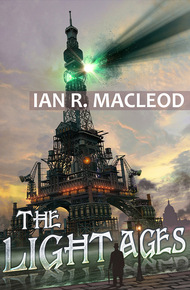
Ian R. MacLeod is the author of The Light Ages, The House of Storms, The Great Wheel and a host of short stories and novellas. His 2008 novel, Song of Time, won the Arthur C. Clarke Award.
Aether is industry, industry is magic and the Great Guilds rule the known world.
Raised amid the smokestakes, terraced houses and endless subterranean pounding of the aether engines of the Yorkshire town of Bracebridge, Robert Borrows is nevertheless convinced that life holds a greater destiny than merely working endless shifts for one of the Lesser Guilds. Then, on a day out with his mother to the strange gardens and weirdly encrusted towers of a remote mansion, he encounters a wizened changeling, and the young girl in her charge called Anna, and glimpses a world of wonder, mystery and surprise.
From then on, as he flees to London in the hope of escape and advancement, and explores its wide streets and dark alleys, and all the tiers of society from the lowest to the highest, he comes to realize that he holds the keys to secrets far bigger than even he imagined.
A dazzling melange of Dickens and Peake, flavored with steampunk and magical realism, yet seen through a kaleidoscopically individual gaze, in The Light Ages, double World Fantasy Award winner Ian R MacLeod has created a novel for this and every age.
A superb fantasia by one of the quiet masters of British fantasy! – Lavie Tidhar
"MacLeod is set to become a writer of the magnitude of Dickens or Tolkien."
– The Guardian"MacLeod's descriptive powers are so effective that you can visualize every detail… [He] skillfully incorporates literary influences ranging from William Blake to Dickens to 1984 and the working class novels of the 1950s—and arrives at something original. Magical, visionary and enthralling, The Light Ages is award-winning stuff."
– SFX"Totally convincing and vividly written, this book invests the dark streets of London with a magic the reader will never forget… a brilliant writer."
– Tim Powers"A haunting fantasy version of Victorian England… brought to life with compassionate characters and lyrical writing."
– The Denver Post"The novel's industrial alternative London echoes Dickens in its rich bleakness and M. John Harrison's Viriconium in its inventive Gothic complexity. A gripping page-turner. A hearty read. Rising star Ian R MacLeod offers an original political fable rivaling in ambition and execution the very best of today's new science fantasies."
– Michael MoorcockI still see her now.
I see her in the poorest parts of London. Beyond the new iron bridges which bear the trams above the ferries, where the Thames spreads her fingers through tidal mud. I see her in a place beyond even the furthest rookeries of the Easterlies, although you will not find it on any maps. Plagued with flies and dragonlice and the reek of city effluent in summer, greyed with smog and ice in winter, even the foulest factories turn their backs away.
There, beyond the hovels and the wastetips of London, I see my changeling.
I see her when I take the streets that lead away from my fine Northcentral house. I see her when I'm worried or distracted, and when the present seems frail. Past the tall Hyde houses. Past the elegant grandmistresses walking their dogs, which—thin-legged, feathered, flightlessly winged, crested like reptiles or covered in mossy clumps of rainbow fur—scarcely seem to me like dogs at all. Skirting the huge shops of Oxford Road, then the incredible trees of Westminster Great Park where prams and parasols drift like paper boats, down Cheapside where the streets grow smaller and dimmer as the sky also shrinks and dims, hazing the roofs and chimneys as evening falls. Clerkenwell and Houndsfleet. Whitechapel and Ashington. A smell of rubbish here and a smell of dogs—by now ugly and ordinary—and the sound of their barking. Not that shame or poverty could ever be said to lie here, although the contrast with the districts where my journey began is already strong. The people who live in these parts of the Easterlies are still all masters rather than guildless marts: they have the jobs that their guilds have granted them; proper furniture in their rooms.
Eventually, long after Cheapside has become Doxy Street, past where the trams reach Stepney Terminus, the muddy streets heave and the houses stick out like irregular teeth. Here in these far Easterlies, no guildsmen dare live. I peer at these people as they scurry in a landscape which seems concertinaed by giant hands, the women cowled in grubby shawls, the men clouded with beerhouse reek, the children quick and pale and subtly dangerous, wondering if this is when the change into true poverty begins.
It always seems that I choose overcast days, late afternoons, dull, hot summer evenings, midwinter Noshiftdays, for my long wanderings. Or at least that, as I step away from the bright core of the Northcentral life I have been living, is what each of these days subtly becomes. From the best districts, I pass through tiers of London smoke and shadow. I suppose that most guildsmen would give up here, if the wild impulse had ever taken them this far. I suppose, looking up at the faces, ageless and leering, that study my passage through holes in the brickwork, hearing the whispering scurry of children both ahead and behind, that I should begin to feel afraid. But people live here: I once lived here, although that was in a different Age. So I walk on and skirt the high walls of Tidesmeet where I once worked through a happy summer. The scurries of the children quieten. The gargoyle faces no longer peer. Someone dressed as I am dressed, practical and understated in a dark coat, high boots to cope with the mud, yet effortlessly conspicuous in the waxy sheen of wealth, clearly possesses money. But I wouldn't bring it here with me, would I? No—or so I imagine those ghost-grey children whisper as they congregate in alleys. And a grandguildsman, too. The repercussions that would rain down on them from the bastard police make murder and robbery seem pointless. And I must have my reasons for coming this way—or I am mad—and both thoughts will make them uneasy. I carry no swordcane, no nightstick, no obvious weapon, not even an umbrella against the rain which always seems to threaten on these overcast days, but to ambush me in that space ahead where the houses press their brows together—who knows what strange guildsman's spells I might be carrying?
Lost also in thought, lost but mostly certain, I wander unmolested through these stinking streets. There are better ways to circumnavigate the far Easterlies and reach the wastetips, although I feel that I need to acknowledge my debt to the place. There are taxi boats and smaller ferries along the main river quays at the embankment and Riverside, which will, on discreet payment of an excessive sum, bear you this way. But the trade they carry is mostly male and drunk, and flounders at midnight from the steps of clubs and guildhalls to sniff the coalsmoke air and dismiss thoughts of home and waiting wives, or even the brothels and dreamhouses, in favour of a different end to the day. Down, then, to the dank sweep of the Thames, where, black-caped and top-hatted, the grandmasters bargain and bluster before they clamber aboard the slopping ferries like tipsy bats. The cough of a motor, the touch of a haft, the whisper of a sail, then away.
It seems to me that all places of poverty are endowed with a sense of waiting, but that is especially the case here, where the houses grow yet flimsier and cease, at some indefinable point like the shifting of a dream, to be houses at all, but shanty hovels of pillaged brick, cardboard and plaster. They are like the theatre props of a play whose essential meaning, despite everything, still escapes me. And the people who live within them, those guildless people whom we call marts, lie so far down the well of fortune from the bright world I inhabit that it is a surprise when their voices come echoing back at me in choked versions of the English tongue. But here, in the grey lull of this dark daytime, I am suddenly the source of much open attention. The strangest thing is that the children, younger now, unthreatening with stark puppy-dog eyes in the bone-bleached thinness of their faces, come up to offer me money, of all things. It lies there in the thin clasp of their fingers. Endless pennies and pounds and farthings of it. Gleaming.
'Take it, guildmaster. A good penny in return …'
'Fine stuff, the best spells,' agrees a slightly older colleague, a girl with hair so mangy that her crown shines thought it, offering from her pigeon hands what looks like a heap of diamonds.
'Last you this whole new Age. Last you a lifetime …'
More of them gather around, sensing my hesitation, and the foul air intensifies as their eyes glitter up at me. They are dressed in bits of old curtain, barge tarpaulin, sacks. They sport jaunty grey frills of old shirts like bits of filthy sea-foam. The threat of knives and ambushes I can take, but this simple offer … And the money, of course, fades. Even as I take a coin from them to inspect as they watch on, uncomplaining, it feels loose, light, grainy.
I wonder now who it is that actually falls for this trick—and whether the midnight visitors are ever quite so drunk, or so desperate. Not that I don't succumb. I choose the child who has shown the intelligence to form the most valuable-seeming handful, which is not money at all, or jewels, but crumpled guild certificates, bonds and promissory notes, and I snatch at paper which feels like winter fog, and ball it in my fist and throw out in exchange all the coins I can find in my pockets, scattering still more behind me as I hurry on.
The Thames never quite seems to be the river I know where it meets the land here. It lies flat and shining as it surges past the ruined shoreline far beyond the docks; oddly clean, all things considered, yet as black—and seemingly solid—as polished jet. The ferries never venture into these currents, and they hang tiny in the pewter distance of evening. They, and the wyreglowing hills of World's End, belong to another world. By now, the children have faded. What waits ahead of me, distant from everything but this river, is a foul isthmus. Sounds are different here, and the gulls remain oddly silent as they bob and rise. Here, it would be said in a forever unwritten history, edged against the wastetips and outflows, shadowed with cuckoo-plant ivy, scratched against the sky, are the remains of the unfinished railway bridge which attempted to stride across the Thames from Ropewalk Reach in another Age. The bridge still rises from the city's rubbish in a tumbled crown. It fails only where the second span buckles beneath the river, waving its girders like a drowning insect. I move within the shadows of its ribs, clambering over slippery horns of embedded concrete and guild-scrolled bearing-sleeves of greenish brass. Here, rusted and barnacled but still faintly glowing with aethered purpose, is the crest of a maker's plate. And a sea-diver's glove. A pulley wheel. And all the endless filth that the river has washed here; tin cans and shoe soles, eels of rope and condom, speckled mosaics of tile and piping.
I begin to make my way up and along the arch which still plunges out across the river, careful not to catch my cloak between the stanchions. There are curls of mist beneath me now; faint shapes over the quick black water which suggest limbs and faces as they twine and turn amid the abutments. And the bridge itself seems to be growing, beams and girders spinning out around me. But I've been here before, and I know something of the ways in which changelings protect themselves. Although my heart is racing and my hands are slipping, I push on and soon I am squatting on a ruined bridge again, caught between nothing but the land, the river, my own desperate need.