Excerpt
Introduction
Donna Scott
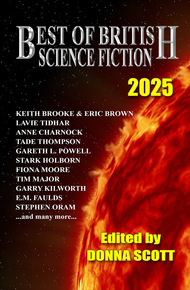
It is wonderful to once again be writing an introduction to another fantastic anthology in the Best of British Science Fiction series after a year's hiatus. I have missed reflecting on the year that has just passed and seeing how world events are reflected in the science fiction that is being currently written. I read so many great stories that I had to let some really good ones slide to keep the book a reasonable size.
It is great to see so many wonderful stories about how humanity can overcome issues through technology and working together in communities. Often these stories have a climate theme, or you can detect some whispers of what was learned by us all during the pandemic. There are stories of generational learning and overcoming differences. I have selected some of the best of these by Fiona Moore, Vaughan Stanger, Lyndsey Croal, David Cleden, Anne Charnock, and Ana Sun.
Not all the stories I liked were so hopeful. I also chose some that are bleak, even horrific. There is body horror in Emma Burnett's story "The Bone Eaters", and strange and sad disappearances that seem to act as a warning to us in Lindz McLeod's "One by One". In addition, Tade Thompson's "The Flaming Embusen" examines the strange phenomenon of digital souls.
I found room for quirky and surreal stories, too, such as Zohar Jacobs' "On the Night Shift" with its very improv mission to Mars, the strange spaceship automaton in Tim Major's "Four Fabrications of Francine Descartes" and a different sort of alternate history story in Caitriana NicNeacail's "Dark Matter".
There are robots, spaceships, new worlds, and new histories aplenty in this assortment of stories. I am also immensely proud to be bringing you the last collaborative story to be published by the wonderful writing duo of Keith Brooke and Eric Brown. "Alba and the Great Crystal" made me cry, and not just because I feel sad that Eric is no longer with us.
The short story zeitgeist of 2025 was decidedly green and concerned with great acts of common humanity as far as I could see. I can only surmise that this might be in reaction to the turbulent state of world politics. This year we have seen the rise of the far right in the Northern Hemisphere, increasing authoritarianism, the defunding of science, clampdowns on free journalism and political comedy, and all manner of scary stuff that continues apace into 2026.
As writers and creators, I think many of us are trying to use our imaginations to fight against the insidious crawl of ugliness in this world. There are fewer AI-based stories this year: it's no longer something to think of as futuristic or far off and we are already seeing the negative effects in terms of reactionary shrinking of the job market (even though AI can't do people's jobs, not really), the spread of misinformation and other horrible fakeries, the depletion of the water table and other environmental costs. Writers are possibly done with the idea of AI and instead we are back to stories of old-fashioned robots or surging ahead to a post-AI world.
If hope has been the creative antidote to all this in 2025, I predict we will see even more hopeful stories in 2026.
– Donna Scott
Northampton
February 2026