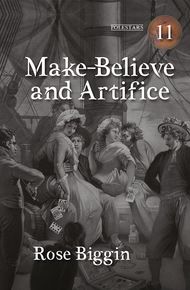
Rose Biggin is a writer and performer based in London. Her previous books are the punk fantasy novel Wild Time (Surface Press) and gothic thriller The Belladonna Invitation (Ghost Orchid Press). She is also the author of Immersive Theatre and Audience Experience (Palgrave). Theatre work includes genderqueer retelling Victor Frankenstein and BADASS GRAMMAR: A Pole/Guitar Composition in Exploded View.
Rose has been a Miss Pole Dance UK finalist and performer on the pole in various theatrical contexts from live art to immersive to circus to cabaret. She is an Associate Lecturer in Creative Writing at Birkbeck (University of London), and has written jokes for BBC Radio 4 including The Now Show and The News Quiz.
She has a PhD in immersive theatre.
Rose Biggin has long been delighting readers 'in the know' with beautifully crafted stories, tales that often play around with myth or classic literary concepts, using them as a springboard for her own unique imagination.
This, her debut collection, demonstrates why she is so highly regarded – as fine a mix of otherworldly fantasy and artful mysteries as any reader could wish for.
Featuring the author's best stories to date, Make-Believe and Artifice showcases fifteen fictions drawn from the past decade, each of which is a diversion to savour.
Prepare to be spell-bound by this debut collection from the terrifically talented Rose Biggin! – Lavie Tidhar
"Effervescent, artful and joyfully mischievous, Make Believe and Artifice dances with the reader at every page. Rose Biggin is a fabulous writer."
– E.J. Swift"With stories as artfully constructed as this, it's difficult to feel bad. For any lover of fantasy or comic fiction, this book is a treat to be savoured."
– Strange Horizons"… stylish, smart, a pleasure to read and [the author] knows when to make you smile and sometimes punch you in the heart too. This is a pure delight of storytelling and an absolute pleasure to read. Very strongly recommended!"
– Runalong the Shelves"An irresistible chocolate box of artful confections… we're transported into new worlds of possibility as the shackles of tradition are shrugged off and a playful, teasing, knowing sensibility is released. By the time I had finished the collection, I felt that not only was I living in Biggin's world but that I always had done."
– ParSecThe Modjeska Waltz
(From the private papers of Irene Adler.)
My first and most intriguing adventure with Professor Moriarty was – in more than one respect – an elaborate dance.
Shortly after the affair I note Dr Watson refers to as a 'scandal', although it had been nothing of the kind from my perspective, I found myself travelling the continent. It was a pleasure to do so, and enabled me to put the unfortunate fire in my London lodgings far in the past. On the occasion the Professor entered my awareness, I had dabbled in reprising my position at the Imperial Opera of Warsaw. Although I declared myself perfectly content with minor roles and chorus parts, I had been coaxed into accepting first a single solo aria, and then a full prima donna position. Indeed, by the time a lengthy tour took me back to London and Moriarty sought me out, it had become rather difficult to enter my dressing room for the sheer density of roses. Such is the life of a performer of my calibre.
It came to me via the usual routes for society gossip, tipping out of the opera boxes down to the 'merely players' on the stage below, the news that the King of B– was organising a ball for his son, to be held in the city; and it was perhaps due to my prominence as the Countess of Figaro that season that I was presented with a gilt-edged invitation. I make no claims on my vanity as an actress (or, indeed, as a dancer) as to why the Professor called upon me. Neither did he wish to accompany me to the ball for the chance to dabble in society. He hinted towards the fact that he and I were the only two minds ever to best our mutual friend, and that this was the reason for seeking me out, and not attempting to gain entry to the ball another way. This did flatter me, I confess. But I have reason to believe, in the cold mist of dawn, that even this was only a front for obtaining an invitation.
I was in my dressing room shortly after a performance of Mimi, given to great acclaim although La bohème does not, artistically, stretch me. A boy brought me a visitor's card – and although I have thought at length upon it since, I cannot now remember why I chose to pay attention to this card in particular, as so many came my way. Perhaps it was the lack of embarrassing praise, confessions of love, poetic follies, amateur drawings. No, only a request to meet, the naming of a respectable teahouse in a fashionable part of London quite far from the theatre, a table number (most intriguing!) and a time. And a coat of arms which I did not at first recognise. I was curious – perhaps the first moves of the dance between us were being felt out, even then. I told the boy to return to the giver of the card with the news that I agreed to the meeting. After that I was preoccupied with rehearsals and fending off would-be paramours until the appointed date.
The teahouse my mysterious companion had chosen was one known for its discretion. Young men hovered around the edges ready for any reason they might be needed, while remaining distant enough that the diners could maintain their privacy. I arrived approximately seven and a half minutes late (as is my wont) only to find the reserved table empty, but as soon as I had announced my name to the maître d and been seated by the window, a cream tea was set before me.
'I do apologise for the mistake,' I said, 'but I have not placed an order.' I did not wish to deprive the cream tea's true owners of their afternoon delicacy.
'No, 's definitely for this table, miss,' said the serving boy as he placed the jam and milk down. 'Sir says you are welcome to start, miss.' Only a slight quiver to his hands betrayed his nervousness; new to the role, perhaps. 'He said to say he'll b-be with you anon.' I recognised the stutter over a learnt line.
I thanked the boy – my companion's impudence was not his fault – and decided to pour my tea. A moment passed, which I spent gazing out of the window, before a silver-topped cane passed by my place and within another moment a gentleman was sitting opposite me.
He wore a topcoat whose slight shabbiness marred its original expense, and when he removed it I noticed that his grey suit, as fine as it was, had begun to fray at the edges. The chain of a pocketwatch glinted from his velvet waistcoat, and the silver-topped cane was placed gently down against his chair, frequently toyed with and never out of his reach. The overall impression was of a man who rarely attended such a social event as afternoon tea, although he could afford to do much more.
'Do I have the pleasure of sitting opposite the great Irene Adler?' he cried. I nodded, and any nervous tension he was carrying disappeared to be replaced by an eager courtesy that belied his years. 'It is an honour to make your acquaintance at last. I do beg your pardon for my lateness; a measure to determine that I would not be surprised by… any unexpected guests.' As I was not fully acquainted with the Professor's criminal reputation at this point, this struck me as only mildly eccentric – not justifiably cautious!
'And you are?'
'Oh! I do beg your pardon,' he stood and leaned over awkwardly to shake my hand across the table – thus compiling a baffling set of social inadequacies that marked him out as a Professor more readily than the chalk marks on his lapel ever would. 'James Moriarty, at your service,' he said.