Peter S. Beagle (editor) is the internationally bestselling and much-beloved author of numerous classic fantasy novels and collections, including The Last Unicorn, Tamsin, The Line Between, Sleight of Hand, Summerlong, In Calabria, and, most recently, The Way Home. He is the editor of The Secret History of Fantasy and the co-editor of The Urban Fantasy Anthology.
Beagle published his first novel, A Fine and Private Place, at nineteen, while still completing his degree in creative writing. Beagle's follow-up, The Last Unicorn, is widely considered one of the great works of fantasy. It has been made into a feature-length animated film, a stage play, and a graphic novel. He has written widely for both stage and screen, including the screenplay adaptations for The Last Unicorn, the animated film of The Lord of the Rings, and the well-known "Sarek" episode of Star Trek.
As one of the fantasy genre's most-lauded authors, Beagle has received the Hugo, Nebula, Mythopoeic, and Locus Awards as well as the Grand Prix de l'Imaginaire. He has also been honored with the World Fantasy Life Achievement Award and the Comic-Con International Inkpot Award. In 2017, he was named 34th Damon Knight Grand Master of the Science Fiction and Fantasy Association for his contributions to fantasy and science fiction.
Beagle lives in Richmond, California.
Jacob Weisman (editor) is the World Fantasy Award-winning co-editor of The New Voices of Fantasy (with Peter S. Beagle). He is the publisher at Tachyon Publications, an acclaimed San Francisco-based speculative fiction press, which he founded in 1995. Weisman is the series editor of Tachyon's critically acclaimed, award-winning novella line, including the Hugo Award-winner, The Emperor's Soul by Brandon Sanderson, and the Nebula and Shirley Jackson award-winner, We Are All Completely Fine by Daryl Gregory. He has also edited the anthologies Invaders: 22 Tales from the Outer Limits of Literature, The Sword & Sorcery Anthology (with David G. Hartwell), and The Treasury of the Fantastic (with David M. Sandner)
Unicorns: They're not just for virgins anymore.
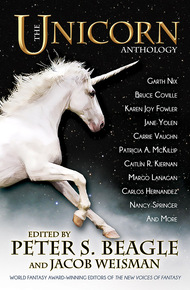
Our intrepid unicorn experts have selected sixteen fantastical stories to radically expand your equine experience. From gloriously uplifting to utterly outrageous, here are spectacular tales of royalty and the undead; innocents and con artists; love and revenge; time-travelers, tattoos—and, obviously, unicorn beer.
Featuring stories from Garth Nix, Peter S. Beagle, Patricia A. McKillip, Bruce Coville, Karen Joy Fowler, Carrie Vaughn, Carlos Hernandez, Nancy Springer, and more.
"Unicorns in literature are fascinating, evocative, mysterious, and elusive, and with The Unicorn Anthology, editors Peter S. Beagle—himself of unicorn fame—and Jacob Weisman invite continued appreciation of the legendary beast, drawing it beyond its familiar medieval framework."
– Foreword"This is a brilliant little collection with a wonderful introduction and I recommend it wholeheartedly."
– Green Man Review"What a treasure trove! This anthology is filled with stories that will surprise, fascinate, and delight you."
– Sarah Beth Durst, author of The Queen of Blood"Between these pages you'll find tales that are as mysterious and arresting as any creature of myth and legend. The Unicorn Anthology returned me to the stories of writers I already loved and introduced me to the stories of writers I know I will come to love."
– Kevin Brockmeier, author of A Brief History of the DeadIntroduction by Peter S. Beagle
The great Irish poet and novelist, James Stephens, whose work influenced my own far more—with every possible due respect—than Professor Tolkien's ever did—got so damn tired of being remembered only for his classic The Crock of Gold (which I discovered in high school) that he simply stopped writing novels at all. Spent the last twenty-five years of his life writing poetry and broadcasting on the BBC. Of Robert Nathan's thirty-odd novels, the only one still in print (thanks to Tachyon) is Portrait of Jennie, just as you'd likely have to dig to find any of Charles Jackson's books but The Lost Weekend—and that only because, like Jennie, it was made into a successful movie. Joe Haldeman continues to write just as notably as ever, but has told me that he's resigned to being recognized always as the author of The Forever War. My late Santa Cruz friend Jim Houston, who wrote several splendid novels about California and Hawaii (one day, surely, someone will film his Snow Mountain Passage, about the Donner Party), equally accepted having Farewell to Manzanar—written with his wife Jeanne, about her childhood years in the Japanese-American internment camps—as what he called "the family franchise." Farewell to Manzanar remains an award-winning TV movie (easily available online), and has been required reading in the majority of American high schools and colleges since its publication. I can't imagine it ever falling out of print.
Actors in a particularly popular role, in some ways, have it worse, of course. At least Eugene O'Neill's father, an actor who fed his family touring The Count of Monte Cristo across the country almost until he died, didn't have to deal with endless reruns. Leonard Nimoy's laudable denial, I am not Spock, was followed, some decades later—after a celebrated career as actor and director spent equally between movies, television and the theatre—by I am Spock. Christopher Lee was very proud of having played not only Sherlock Holmes but also Sherlock's "smarter brother" Mycroft (not to mention Dr. Fu Manchu); but to most viewers and fans he was forever Dracula. And glad to get it, as he said himself, "No Dracula . . . who knows?"
So it's become for me. The Last Unicorn isn't my favorite of my own books—for that matter, there will always be people who feel that I never wrote anything better than my first one, A Fine & Private Place—but without that damn unicorn, would so many people have discovered my ghosts, my poetic wanderers, my woman warriors, my ragtag wizards? To quote Christopher Lee, who knows?
I've tried to shuck off the beasts over the years, telling people about my longstanding offer to the late blessed Ursula Le Guin to trade my unicorns en masse even-up for her magnificent dragons. It was a mock-serious joke between us, on the rare occasions when we ran into each other, but it was serious enough as far as I was concerned. In 1968, when The Last Unicorn was published, I still didn't really think of myself as a career fantasist, even with A Fine & Private Place, "Come Lady Death," and "Lila the Werewolf" constituting my entire oeuvre to that point. And The Last Unicorn had been such an exhausting, frustrating horror to write (the only bits I remember enjoying were the incidental song lyrics, because writing songs is always a joy) that there was no way in the world that I was going back, ever, to that fairytale nightmare. Not a bloody chance, boy.
So I wrote The Folk of the Air, eighteen years later. It took me four drafts, and really should have gone through a fifth. There aren't any unicorns in that one; but by then I was living primarily off film and television screenwriting jobs, and I can tell you without the slightest fear of contradiction that there are no unicorns in Hollywood. Dragons, yes—unicorns no. None.
But I did at last go back to my unicorn and her world of kings and magicians and plain countryfolk, and beasts as legendary as herself. I went in the company of a valiant, aggravating nine-year-old girl named Sooz. And I'll be going back there again, because Sooz is seventeen now, and she has a journey to make—which I dread far more than she does, because she doesn't know any better. She never does. She just goes on.
It was Sooz who led me to embrace my Inner Unicorn Guy: that four-year-old who stood in front of his mother's elementary-school class (so family legend always had it) and told them all about unicorns. When the class ended, he said politely, "Goodbye—I'll come back sometime and tell you more about unicorns." Anyway, that's what my mother always told me.
Because of Sooz, who has only once taken no for an answer (that was from an aged, near-senile King Lir, whom she fell in love with), I've written stories about Chinese and Persian unicorns, a pregnant unicorn choosing to give birth on a rundown little farm in Calabria, a five-inch-high unicorn liberated from an ancient tapestry by Japanese magic, and trapped in an art gallery; even a unicorn in colonial Maine—a vision vouchsafed to a career con-artist named Olfert Dapper, who knows that he has no right in the world to the sight of it. Dr. Dapper (as he shamelessly titled himself) happens to be one of the two people to whom The Last Unicorn is dedicated. So I knew something back then, fifty years ago, even though I wasn't about to acknowledge it.
I've written about mermaids as well, not to mention giants and spooks and dybbuks—and even two dragons: one permanently pissed-off (at me, as it happens), and one soft-hearted dragon, who loves a princess as chivalrously as any knight. I have an old tenderness for all manner of shapeshifters (always wanted to be one, I guess); and a particular being of my own, called a chandail. And then there's the Shark God, his human wife, and his two troubled, demigod children. I'm proud of them all (especially Mrs. Eunice Giant, who declares indignantly to Jack, "I'm not either a monster! I'm big, yes, and I've got dietary needs, like you or anyone else!") Looking back, I love them all.
But the unicorns are . . . not special to me, not exactly, but something I've never had a word for. Olfert Dapper, of all people, hears it—or something as close to it as I can come—from a Puritan woman named Remorse Kirtley, citizen of a colonial settlement called No Popery, who has held a unicorn's head in her lap, and looked into its eyes.
"The unicorn set me free, can you understand me? Freed me from the world I have always been taught, and always believed, was the only world for a Christian soul. While I sat there and held him, he came into me—how else should I put it, dear Doctor?—he came into me and showed me the magic beyond poor, crabbed No Popery, the beauty beyond the sour singsong God of my worship . . ."
They are beautiful and mysterious, far past our understanding of either word. They have been, over the endless millennia, sometimes curious—even fatally so—about humans; sometimes—rarely, and only according to their own imagining of that word—generous. But they do not know love, and they are incapable of regret. Only one unicorn was ever born who could regret. It cannot be said to have served her well.
And perhaps that is why—speaking as a human being old enough to envy unicorns' freedom from such things—they still haunt the corners of my failing eyes, and of my dreams. Of all the beloved shadows, they remain, to paraphrase, of all things, the poignant old Rodgers & Hart song, "too beautiful to be true," leaving us all, as in the song, fools for beauty.
It's a little difficult for me to present an unbiased view of the stories included in this anthology, because so many are either by old friends of mine, like Patricia McKillip, Karen Joy Fowler and Nancy Springer, or people whose work I've admired for years, such as Garth Nix and Caitlín R. Kiernan. (I think "The Maltese Unicorn" just might be my favorite story of the collection. And I'm particularly delighted that its publication has raised money for Boon Lott's Elephant Sanctuary, among other wildlife charities. Elephants may not be unicorns, but they are magical in their own right, and splendid as well. Unicorns aren't splendid, or any other such word. As I've been trying to say through this foreword—indeed, through my entire odd career as the Unicorn Guy—at the last, there is no word to describe what a unicorn is. No word that I know, anyway.