Kristine Kathryn Rusch sold more than 35 million books worldwide. She publishes bestselling science fiction and fantasy, award-winning mysteries, acclaimed mainstream fiction, controversial nonfiction, and the occasional romance.
Her novels made bestseller lists around the world and her short fiction appeared in more than twenty best-of-the-year collections. She won more than twenty-five awards for her fiction, including the Hugo, Le Prix Imaginales, the Asimov's Readers Choice award, and the Ellery Queen Mystery Magazine Readers Choice Award.
To find out more about her work, go to her website, kriswrites.com.
facebook.com/kristinekathrynruschwriter
patreon.com/kristinekathrynrusch
bookbub.com/authors/kristine-kathryn-rusch
bsky.app/profile/kristinerusch.bsky.social
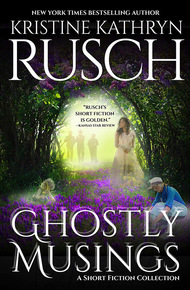
Playful to scary, fanciful to dangerous, discover ten delightful tales of ghosts and haunts.
International bestselling author Kristine Kathryn Rusch shares ghost stories that span her long career, from the Bram Stoker nominated novella, "Phantom," to the haunting "Except the Music." Rusch's appearances in dozens of best-of-the-year collections and her many readers' awards establish her as a master of the short fiction form.
"Like early Ray Bradbury, Rusch has the ability to switch on a universal dark."
—The London Times
Our final exclusive is mine. I've never collected my ghost stories in one place before. I assembled this collection expressly for the StoryBundle and found a lot of surprises inside the stories. I had no idea that I connect ghosts and the arts quite firmly. In addition to the short stories, you'll find a novella that I'm quite proud of. Enjoy! – Kristine Kathryn Rusch
"Like early Ray Bradbury, Rusch has the ability to switch on a universal dark."
– The London Times"Kristine Kathryn Rusch's…stories are exceptional, both in plot and in style."
– Mystery Scene Magazine"Rusch is a great storyteller."
– Romantic Times"[Rusch's] short fiction is golden."
– The Kansas City StarInspiration
by Kristine Kathryn Rusch
The steering wheel was cold. Frank held his raw red hand over the vent leading to the Oldsmobile's sporadic heating system. The clear Wisconsin night seemed fresh; subzero temperatures hardened the edges on the world, made it sharper. Even the night sky was blacker than usual.
Frank pulled his down jacket tightly around his shoulders. The gun felt solid against his hip, protection against such a cold night. He glanced at the books on the seat beside him. All of the covers depicted a man and a woman in an embrace. All of the couples seemed to be experiencing some form of ecstasy. He ran his fingers along the smooth surface of the latest book cover, along the raised edges of Catherine Rice's name. He had read, in one of the romance magazines, that they called her Cat. The name suited her. The author's photo inside the book cover could have doubled for any one of her heroines—the wide, almond eyes; the soft, seductive smile; the high cheekbones and the shiny, shoulder-length hair. He didn't know the color yet—of her eyes or her hair—but he would soon enough.
Christmas Eve was the perfect time, the time to catch anyone home, even the writer of best-selling romantic fiction. Unless she went to church. But judging from the sensual content of her books, Cat Rice didn't go to church. She seemed to believe in a higher power, but that higher power wasn't necessarily Christian.
Snow covered the rolling farmland. Small wood-and-wire fences ran along property lines, making a wind barrier so that drifts wouldn't pile on the roads. Every mile or two, a farmhouse loomed, usually decorated with multicolored lights around the huge picture window. Frank would tense, and then relax. Her farm was ten miles up Highway 12, where Springfield-Lodi Road converged in a strange angular corner. The farmhouse had been standing on that corner since he was a boy. He knew where she lived. He simply couldn't believe his luck in finding her.
A Christmas present to himself, meeting his favorite author. He had imagined the scene a thousand times: Cat opened the door, tears reflecting the green of her eyes. She was suspicious at first, but his kindness, his solicitation at her obvious loneliness, led her to invite him in. They shared mulled cider and gentle kisses beneath the glow of her Christmas tree, and she let him touch her…
But sometimes his fears took over, and he knew that a famous woman like Cat wouldn't want a man like him, a man who had worked on a Janesville assembly line since he was sixteen, attaching this doohickey to that doohickey, meeting his hourly quota, listening to the roar of the machine…until two days ago, when the company announced its annual holiday layoffs—and laid him off for the first time in twenty years.
No. The men she wrote about weren't always rich, but they were always bright and intelligent, educated and witty. Sometimes the scenario got away from him. Sometimes, in his imagination, she would slam the door and dial the police, and he would tear inside, rip the phone from her hands, and shove her on the couch, reaching for her clothes, the soft skin inside, taking instead of letting her give.
Sometimes he ached, and not even the gentle sensuality of Cat's books could ease him. She would understand that. She would have to.
* * *
John watched Cat lean on the dirty stonework in front of the fireplace, wishing that he could help. He hated the inequities in their relationship. There were so many things that he wanted to do that he simply was not capable of.
Cat stuffed wadded paper between the logs and the kindling, then grabbed a kitchen match, pausing for effect. "Cricket on the Hearth," she said.
John wrinkled his nose. Every year they had read Christmas stories to each other. This year he had chosen Dickens as the author. John leaned back against the art deco, restored 1920s sofa. "I prefer The Chimes."
Cat struck the match and watched the flame burn blue, then gold. She tucked the match against a piece of paper. The paper ignited, burned and crisped without so much as charring the kindling. "How about A Christmas Carol?"
He snorted. "That's everyone's favorite. I'm sick to death of it."
She lit two more matches and tossed them on the pile of wood. Papers caught, and finally kindling did, too. "That leaves The Haunted Man."
They stared at each other. John sighed and brushed a strand of hair from his face. "No, thanks."
Cat picked up the copy of Dickens's Christmas Books that lay on the rug just beyond the stonework. "Here," she said, tossing the book at John.
His hand closed around the book, only to have it fall through his fingers and thud on the glass top of the coffee table. "Wrong year."
She frowned, scooted over to the table, and opened the book to the copyright page. "Nineteen fifty-nine."
"Half of '59 is good; half isn't," he said, and winked out, leaving her to stare at the indentation in her antique couch.
"I hate it when you do that," she said. He could tell from her tone of voice that she was uncertain whether he was still in the room. Sometimes he wondered himself why he did that. Perhaps it was a way to reestablish their distance, a distance he didn't want to feel, either, but had no choice or control over.
"It's Christmas Eve. We still haven't decided which Dickens story to read in front of the fire."
He knew it was Christmas Eve, and the knowledge frightened him. He had died thirty years ago this night, and he was due for a review—which would either result in a renewal or in his final rest.
He didn't want to leave Cat. She was so small and vulnerable. And he was not helping her by keeping her focus on him. Yet it was that focus that had given life to her romances. Sometimes he wondered why she didn't write horror.
She pushed the Dickens aside as if it hadn't mattered. He was being foolish. She had planned a nice, romantic evening, and he was ruining it. Damn the rules anyway. He had never been through a review before. Sometimes, he was told, the Powers Above conducted a reenactment. Sometimes they snatched a shade in the middle of a project. And sometimes they didn't do anything at all. They did watch, though, and they did enforce the one rule that John really hated: he could touch anything made before his death, but anything made afterward wasn't solid to him. Cat had been born in 1961, January. Conceived in 1960, about one year too late.
On the other hand, romance novels made perfect sense. She had to relieve the sexual tension somehow.
"The Chimes," he said, his voice sounding hollow and echoey like it always did when he was invisible. "You'll get all the good cheer and Victorian social satire you can stand for a single evening."
"I'd rather have sex," she mumbled.
As if he wouldn't. But he didn't want her to know that he had heard. "What?" he said.
She sighed. "The Chimes is fine."
* * *
The farm loomed ahead, its yard light shining like a well-directed beacon against the night sky. In the yard he could see an unused tractor and a dilapidated barn. The house itself—an old turn-of-the-century two-story, big enough for a family full of children—had light in its curtained window. Through the main window, he thought he caught the multicolored glimmer of tree lights.
Come in, she said, tears glinting in her green eyes.
A shiver of anticipation ran down his back. He pulled the car over onto the shoulder and shut off the engine. The night was so cold, and the car was so junky-looking, anyone would assume that it had simply broken down. He got out and slammed the door. The ca-thunk! echoed in the stillness. He hadn't seen a single car this evening. Good thing, too, considering the half mile he had to walk.
He had planned it well, figuring that she would let him in to use the phone. Country folk were still hospitable to people with car trouble. With the distances between houses and the bitter cold, no one wanted to be responsible for someone else's death. He was counting on that kindness. The holiday would help, too.
He jammed his hands in his pockets and began to walk, his boots making little squeaking sounds on the snow.
* * *
John grabbed the knife and the wine, and proceeded to open the bottle, moving a little away from the table so that he wouldn't knock over the antique crystal goblets she had set out. Cat went to such lengths to include him, and he enjoyed it. Sharing wine with Cat made him feel almost human, almost alive again. The alcohol would slide down the back of his throat and warm him. For one short moment, he could imagine that with a simple movement of his fingers, he could touch Cat, bring her closer to him, make love to her.
A simple movement of his fingers. All it would have taken to save himself instead of Britta thirty years ago.
Even if he had survived, he would have been too old for Catherine. A seventy-year-old man and a thirty-year-old woman often married for money or companionship, not the kind of love Cat wrote about in her books.
The cork slid free with a squeal. "How about something nontraditional, like A Tale of Two Cities?"
Cat giggled. "God, we'd be up all night."
Like they so often were when she finished a book. She would read to him, knowing that he couldn't turn the pages of something so fresh, even if she wrote it on decades-old parchment. Those nights were as close to loving as they could get—John sprawled on the couch, feeling the heat of the fire, eyes closed as he imagined himself the hero of the novel, and Cat the heroine. She never said, but he knew that was what she saw, too. And he also knew that he was her spark, her inspiration. He had read the two novels she wrote before she came to the farm, before she found him. The prose was as good, but the characters were lifeless. The man seemed like a modern-day Heathcliff, done as poorly as a thousand other such characters; and the woman wayward, timid, and determined, rather like Cat when she had moved in. He smiled, remembering the first time he had seen her, trying to drag her antique couch up the stairs on a dolly. He had stayed invisible as he held the end of the couch, easing the weight so that the bumping wouldn't damage the furniture.
He had worried about such things after she moved in, little helps that he made, worried that one of them would be the selfless act that would lead him away from Cat, to his final rest.
"Are you going to stand there, staring into space like you had a calling from the Angel of God, or are you going to pour the wine?"
Cat held out her glass. He grinned and poured, enjoying the clink of glass against glass—a sound he had caused. She sipped the amber liquid and smiled at him.
He poured his own drink, and then lifted the goblet. "To you," he said.
She touched her glass to his. "And to our future," she whispered. But he didn't drink. He never drank to that toast, for neither of them quite understood the meaning of it.
* * *
The walk was farther than it originally looked. Frank's nose ached, and his eyes stung with cold. The jacket he wore had thinned over the years, and he found himself shivering in the meager warmth it offered. He stared at the house ahead, the unwavering yard light, and the curtained windows. Sometimes he thought he saw a shadow moving across the room, but sometimes he thought he had imagined it.
He made himself concentrate on her books. In them the first meeting was always important, sometimes rocky, but crucial to the rest of the story. Very rarely did the hero introduce himself to the heroine, but once in a while it happened that way. Just like now. He had picked a magical night to meet a marvelous woman, and he knew that things would go well.
He had reached the bend in the road, where Springfield-Lodi curved off the highway. The house stood before him across a wide expanse of unbroken snow. The place looked foreboding somehow. He ran a hand across his stomach, feeling the nerves jump. He hadn't approached a girl in a long time—not since Sue Anne on the assembly line.
Sue Anne. He swallowed hard. He thought sure they would fire him after that. It wasn't his fault that she died. She had lied to him, led him on—and then, when he challenged her, she had denied everything, said she hadn't wanted to hurt him.
Well, he hadn't wanted to hurt her, either.
He swallowed, shrugged off the memory, and walked around to the frozen, mud-covered driveway. A cleared path led to the house. He walked cautiously, thinking of the books, thinking of her—as he had thought of her a hundred times on his assembly line, as he reached here, then there, then here—
The door came too soon. He hesitated for an instant, staring at the plastic, snow-dusted wreath on the weathered wood. There was something about this house. Someone had died here when Frank was very young. He shivered, thinking he hadn't been this cold in a long time, and then he knocked.
* * *
"Or I could do the entire Christmas Carol from memory," John said. He winked out, and his voice became eerie and hollow. "I wear the chain I forged in life. I made it link by link and yard by yard, I girded it on of my own free will, and of my own will I wore it. Is its pattern strange to you?"
He reappeared next to the Christmas tree, grinning at his own cleverness. Cat had her head cocked to one side, as if she were listening.
"I think someone knocked."
His grin grew wider. "Looks like it is A Christmas Carol, then. Although the clock is supposed to strike before we hear anything."
"I'm serious," she said. "Who would be here tonight?"
The words chilled him. Britta had said the same thing on the same night thirty years ago. And he had been silly then, too, teasing her that what she heard could have been a bit of undigested beef, a blot of mustard—A Christmas Carol again. Funny how he had forgotten that when he suggested Dickens this year. "We could see if they go away." His voice sounded hollow even though he was still visible. He didn't think he could be nervous, but he was.
The knock sounded again. Louder.
"I'm curious." She walked to the door. A wind chime, made of small glass angels, tinkled in her wake.
John followed, not afraid to show himself to anyone. Her family lived out of town; her friends were gone for the holidays—all she had was him. Whoever was at that door was a stranger.
She pulled open the door, sending in cold air that even John thought he could feel. The man behind the door was small, but powerfully built. His arms in his thin jacket were brawny. He wore no hat, and the tips of his ears as well as his nose were red.
The man's gaze flickered to John and then to Cat. "My car—I mean, I got—I mean, I'm sorry to bother you."
"Do you need to use the phone?" Cat's voice was warm, solicitous.
The man nodded, but John could feel a lie. The man came in, and John moved beside Cat, reaching around her to close the door. The solid wood felt good to him.
"Thank you, Miss Rice," the stranger said.
* * *
The instant he said it, he knew he had made a mistake. The chill seemed to seep deeper into Frank's body. He looked at the shock on Cat's face, to the thin disapproval on the face of her man. Her man. The magazines never said anything about a husband. Or any kind of boyfriend. He should have known she would have someone here, but somehow that had never figured into his scenario. Stupid. Stupid. He was stupid to be here, just as she had been stupid to lead him on with those books, those promises of hers.
"You know who I am?" Cat asked. She had taken a step back from him and crossed her arms in front of her chest. Her hair was brown—almost mousy, and her eyes a deep blue. The details pleased him even less than the man did.
"I—I've read all of your books. I thought, for Christmas, I'd meet you."
He saw the shades click down, the public persona slip into place. "Well," she said, and the warmth in her voice was as false as the wreath on the door. "Why don't you have a seat, Mr.—?"
"Frank," he said.
"Frank." She glanced over her shoulder, and he saw what she was looking at. The phone in the nook near the kitchen door. "You look cold. Would you like some wine?"
"No, thanks." This was slipping out of his control, first the man and now her chill. He looked over at the door. The man was gone. But he hadn't walked through the room. He had simply vanished.
Frank felt relief slide through him. The man hadn't been there at all. A projection, a trick the back of his brain was waiting to play on him.
"I have some books in the back," she said. "Let me get them and sign them for you. It was so nice—"
He grabbed her wrist. "I have the books. I was actually thinking of spending a nice evening, just talking."
"Oh." The tightness of her movements sent little ripples of anger through him. She didn't want to be near him. Like Sue Anne, she didn't want to be close. "You'll have to let go of me if you want me to sit down."
He did. He let her free. And he saw the red marks his fingers left against her skin. And suddenly he wanted to leave more, to show her how silly her romance was. No one had that. Not even her, alone on Christmas Eve. He slid his gun out of his pocket, grabbed her wrist again, and pulled her close, sorry that it had to be like this, but knowing that it would always have to be like this.
* * *
Just like Britta. Only this time the man was after something other than money. This time there was no split second to push her out of the way, take the bullet himself, only to lose her, too. Funny how saving her had caused him to lose her. Britta had never returned, not wanting the memories. And John had waited, all these years, until Cat.
Cat wasn't struggling. She was staring at the gun, probably waiting to see what John would do. And he could do a dozen things. Only, he didn't want to lose her, too.
John stood in the kitchen doorway, careful to be only partially visible. The stranger was waving his gun at Cat, asking her to take off her clothes. She didn't move. John took the knife from the table, hefted the blade a little. If he killed the man, another man might join them, an unwelcome ghost. But if he let the man kill Cat, then John and Cat would be together, finally, able to touch each other…
Unless this was his renewal. If John were to go to his final rest, Cat might take his place as the spirit of the house. He couldn't allow her to feel this kind of loneliness, this kind of isolation.
At the last instant, John grabbed the wine bottle and hurled himself across the room, fully visible. As he had hoped, the man raised the gun away from Cat, at John, and the shots echoed yet again, bringing back Britta's cry, the moment of fading consciousness, the fear that she wouldn't survive. But Britta, like Cat now, had attacked. Cat shoved herself against the attacker, knocking his gun free and sending it skittering across the hardwood floor. John brought up the wine bottle, spilling wine all over himself as he clubbed the man's balding head. The man landed on the floor with a heavy thump.
For a moment both John and Cat stared at the stranger. He seemed less threatening now, more a frightened, misguided child.
"Thank God he was over thirty," Cat said. John smiled, ready to take a sigh of relief when he felt himself wavering. The fading feeling, like the one he hadn't felt in thirty years, was coming back. He wondered how. His act wasn't selfless. He hadn't sacrificed himself. Or maybe he had. Maybe he had done so earlier and had forgotten, and in his review, they decided to take him from her.
But I'm her inspiration, he thought, reaching for her, hoping that in this one last instant, a merciful God would let him touch her, just once—and his hand passed through, as it always had.
He knew that Cat didn't understand. She was hurrying for the phone, for help, for something to bind that awful man with. She didn't realize that John was fading, finding a final rest that he did not want.