R.M. Olson writes feel-good space opera featuring diverse casts, found families, and loads of action. R.M. has ridden the Trans Siberian railway, jumped off the highest bungee jump in the world, gone cage-diving with great white sharks, faced down a charging buffalo bull, and knows how to milk a goat. Currently they reside in Alberta, Canada with their four children, three cats, and a dog the size of a small bear. R.M. goes hiking and skiing more often than they probably have time for, eats more chocolate than is probably good for them, and reads more books than is probably prudent.
Link (my website): www.rmolson.com
R.M. Olson has published several novels, and their short stories have appeared in various anthologies, most recently Skull X Bones by ZNB press. "Blackrock," R.M. Olson's story from that anthology, is currently a finalist for the 2026 WSFA Small Press Award for Short Fiction.
The portal that appeared in what was once open space on the edge of the Joias System should be impossible. So should the alien capsule that came through it. What's inside the capsule is even more unbelievable—proof that the aliens have a cure for a disease that's killed millions. And proof that they want to communicate.
Aran Romeu, a field-scientist desperate to save his dying friend, will do anything to find that cure. Savina Moya, an assassin on the run, sees the portal as her only escape from the government agent sent to kill her. And Alba Espina, the system's Chief Justice, has realized that if she can't find a way to open peaceful negotiations before her military-minded political rival throws the system into an unwinnable war, the portal represents a potential extinction event. Three people thrown together into the unknown. Different agendas. Deadly secrets. And no idea if the aliens who sent the invitation plan to save humanity… or end it.
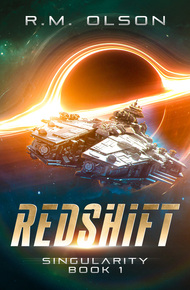
Redshift is the first book in R.M. Olson's thrilling Singularity series, full of action, twisty politics, and diverse, unforgettable characters.
If you have not yet ventured into the realms of R.M. Olson, this is your chance. R.M. has a great talent for writing exciting space opera novels filled with high-stakes drama, exotic settings, unforgettable twists, and heroic characters. I know this particular book will hook you with the story of a mysterious alien portal and three very different adventurers attempting to penetrate its secrets for their own individual goals. By the time you've read this book, you'll understand why R.M. is such a dynamic voice in the space opera field and their work is making such a big splash with readers who can't get enough of their trademark breakneck action and richly developed characterization. – Robert Jeschonek
"Olson's characters are brave, wreckless, always asking questions, determined, brilliant, and most of all warm. It is that warm and kindness that can be felt throughout the story, and makes this an excellent read. 10/10!"
– Amazon review"This is a rollicking ride of a book. It's perfect for those who want to binge read through a series (more books on the way), with characters that are intriguing and a soap opera tale to plunge into."
– Amazon review"I absolutely fell in love with Aran, Istvay, and Ani. It's impossible not to. What I didn't expect was the way the morally neutral characters would slowly gain my sympathy as the complex layers of their personalities were revealed."
– Bookbub review"An intriguing group of characters whose many diverse backgrounds and objectives create a melting pot of interactions, leading to a story that will keep you reading long into the night. Looking forward to the next book in the series."
– Amazon review"This is an immersive page-turner of a novel with a fresh and compelling plot. The characters are flawed, believable, and wonderful to read. The casual diversity and inclusivity is a joy to read."
– Goodreads review"This was an absolute delight. Aran, Istvay, and Ani were the heart of this story for me — a gentle autistic scientist and his beautifully queer little family? Sign me up (And I need an emotional support murder-octopus, like, immediately.)"
– Goodreads reviewThe Council reconvened early the next morning. Alba arrived at the Council room at seven o'clock, a full two hours earlier than usual, to find it already filled almost to capacity. Counsellors were gathered in small groups talking and gesticulating, standing slightly apart paging desperately through holographic tokens from the newsstands, or with the glassy, distant stare of people reading through the retinal screens on their wavelinks.
President Seguer stopped her with a hand on her arm as she pushed her way grimly towards her desk. He looked as if he hadn't slept at all the previous night, and Alba couldn't blame him.
Of the three branches of government, his was the only one whose mandate could be directly repealed by the system's citizens. Which meant the consequences of every decision, good or bad, would be his to bear.
She couldn't muster much sympathy—Ander had always been more concerned about maintaining his position than he had about what that might mean five or ten or fifteen years down the road. He was still in his late fifties, and didn't have the heavy weight of experience, good and otherwise, that had come to colour Alba's decisions.
"Alba. I know the General's been talking with the others, trying to convince them the Military Committee is best suited to deal with this—but do you think he may be right on this one?" Ander's face was pinched with worry, and drawn with lack of sleep.
Alba turned a scornful glance on him. There was a reason why she'd never been particularly fond of the man. "I stand by the statements I made when I presented my proposal," she said curtly. "Now, if you'll excuse me—" She brushed past him, but she couldn't ignore the hard knot of worry in her stomach.
If Cavaco had half-way convinced the President already, it wasn't a good sign.
The Speaker called them to order a few minutes later, and the sudden quiet, after the deafening buzz of voices, was an indescribable relief. Alba leaned back in her chair, aware, suddenly, of the weariness in her muscles, the stiffness in her joints.
"Madam Speaker, if I may." Cavaco rose to his feet, and the Speaker tapped through control of the holodisplay to his desk.
He didn't speak immediately, pausing to cast his gaze across his assembled audience. "My friends and colleagues," he began at last, his voice crisp and precise. "We are in the midst of a situation of unprecedented threat. The world as it existed when we stepped into this chamber yesterday morning is gone, irrevocably." He paused a moment, as if to judge the impact of his words, then, with a sudden, involuntary glance at Alba, he continued hurriedly.
She smirked.
"Only yesterday," he continued, "we were debating a proposal to disband the Military Committee entirely. Now it appears this very branch of the Council may be the only thing standing between our planet, indeed, our solar system, and destruction. I've been in consultation with our top scientists—notable among them Emeric Furtado, who presented the discovery yesterday—and it seems they are in agreement with myself and my associates. Based on what little we know of these aliens and their technology, our best, and perhaps only, hope is to attack first, while we can maintain the upper hand."
He paused again for effect, recalled himself, and tried to hurry on, but he was too late. Alba had been waiting for just such a miscalculation, and she rose and addressed herself to the Speaker before he could open his mouth.
When she'd been granted the floor, she turned a scathing glance on Cavaco. "The scientific community is in agreement with you," she repeated. Her tone dripped disdain, despite the quick pounding of her heart. "Then I assume you'll be more than happy for me to call them immediately to verify. It's always possible for messages to get distorted in the transmission." She made no effort to hide her contempt as she tapped the communication device on her desk to page the door steward. "Would you be so kind as to contact the Sao Martim University research laboratory and inform them that the Council wishes to speak with them via wavelink?"
If she was wrong, she'd just orchestrated her own grand failure.
But she was certain she wasn't wrong. Her past ten years of research couldn't have been upended overnight.
A moment later, a holoscreen popped up in the centre of the room over the podium.
The young scientist from the previous day, Emeric Furtado, appeared, looking dishevelled and uncomfortable. He was flanked by a handful of his associates.
"I understand you've been discussing this new development with my colleague, General Cavaco, and, in your infinite wisdom, have determined the most expedient course of action for our government," she snapped.
The other scientists looked even more uncomfortable, if that were possible, but Emeric rallied slightly. "Madam Chief Justice. We certainly had no intention of telling the Council its job," he said. "However, General Cavaco asked our opinion on certain matters, and we deemed it our duty to—"
"You're a biologist, am I correct?" Alba cut in.
He stopped, somewhat taken aback. "I—"
"And your field of expertise is molecular biology?"
"I—" he looked distinctly flustered now.
"The rest of you—" She turned her gaze on the hapless scientists gathered behind him, all clearly unhappy to be there. "Have all the molecular biologists in your department developed such strong views on how to interact with alien entities?"
There was a shuffling of feet.
She turned back to Emeric, who was clearly trying to gather his dignity. "Since you alone, out of all the molecular biologist of the research institution, seem to believe that your expertise compels you to recommend a course of action to government officials in matters of inter-species relations, perhaps you will enlighten us as to the information upon which your conclusion is based."
He cleared his throat, glancing around in vague desperation. "I, um—that is, I … the biological markings on the blood sample we examined indicates what I believe to be a genetic predisposition to aggression," he finished finally.
Alba raised her eyebrows with a look she'd perfected over her years on the bench, eloquent enough to send a bloviating lawyer slinking back to their desk, head lowered in shame. "A genetic predisposition to aggression," she repeated, sarcasm veritably dripping from her words. "That is a groundbreaking discovery indeed. I assume you constructed this hypothesis based on thoroughly peer-reviewed research?"
He was silent.
"Come now, I'm certain you wouldn't advise this government to stake the survival of our entire system on a hypothesis not based firmly in data and fact. I'm simply inviting you to refer me to the materials upon which you relied on in coming to your groundbreaking discovery."
He shifted uncomfortably. "I—the, er, the research I relied on was something I've been—I—I intend to publish it shortly, and then, I'm certain, once it's gone through the peer review process, I'd be more than happy to—"
She cut off the line with a flick of her wrist, and turned back to the room. "General," she said, her voice losing none of its ice. "It appears the scientist who advised you may have been a touch precipitous in his recommendations, does it not?"
From the look on Cavaco's face, the young scientist would be hearing from his benefactor that evening.
"As I stated yesterday morning, from a world that, as the General has so poetically informed us, is gone forever, all the reputable research," she leaned into the word with just a touch of malice, "research, that is, done by scientists who are experts in the field, agrees that the method most likely to be successful in initiating contact with an alien species, especially one of unknown technological and military capabilities and uncertain motives, is not to antagonize them, but to attempt to open a dialogue."
She turned to face her fellow counsellors in the rows of seat rising behind her.
Her hands shook slightly.
It wasn't that she wasn't confident in her factual position—she was entirely certain of it. But she was not accustomed to politicking without making sure of her political position first.
And the stakes of this particular political decision were unimaginably high.