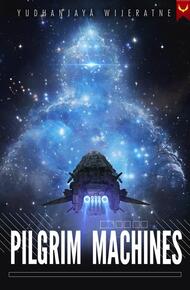
Humanity has met an intelligence so far beyond its own that it makes us look like children. The long-haul freighter PCS Blue Cherry Blossom, is sent toward the heart of the galaxy to find out what is out there and whether anyone can survive it. Political and corporate maneuvering follows them the whole way.
The voyage takes the ship past every chart humans have, and it changes everyone aboard. Set in the world of The Salvage Crew, this is a standalone novel for readers of We Are Legion, Murderbot, Blindsight and Star Maker.
"Yudhanjaya Wijeratne's novel Pilgrim Machines is a everything I think of when I try and imagine what science fiction can and should be . . . the world in which we exist is endless; beautiful and terrible all at once."
– Andrew Liptak, Transfer Orbit"Full of epic scenes, surprises and just a great central inhuman character to meet and understand."
– Matthew Cavanagh, Runalong The Shelves, who called it one of his favourite SF reads of the year"Very fun romp through the galaxy as humanity expands towards the galactic center."
– John Ludwig, A Little Ludwig Goes a Long Way"A journey about enlightenment, about discovery for the sake of discovery and transcendence for the sake of becoming better aware of our existence. Yudhanjaya Wijeratne's novel Pilgrim Machines is everything I think of when I try and imagine what science fiction can and should be: an optimistic and beautiful journey into the cosmos that tells us something about ourselves."
– Andrew Liptak, author of Transfer Orbit and Cosplay: A History"If you mixed the intellectual heft and inquisition of Arthur C. Clarke with a slightly boozy raconteur on a Friday night, albeit one armed with the fountain of all human (or otherwise) knowledge, it would probably sound something like Pilgrim Machines."
– Thomas Trang, author of Dark Neon Dirt and The World Behind UsCHAPTER 0
The Stranger and I blazed a slow trail through the darkness, very carefully keeping our distance. I wish we could talk, but the Stranger tended to fall silent for long periods of time. Maybe it slept. Maybe it was waiting for me to say something interesting.
Eventually, we saw something: a body in the distance, about three Jupiter masses. It was as alone as we are. I signaled a turn and made a sharp beeline for it.
It was a rogue planet, the eighth I've seen since we met. The first three were interesting; now I found myself bored with this.
I did the usual. Stop, record everything I have about the object, annotate everything I can think of. Planet. Rogue planet. Planet without a sun. Rock. Ice. Residual core isotope decay. Atmosphere: mostly nitrogen. Colors: gray, blue, white. Possible weight. Height. This I sent to the Stranger, one gargantuan text-and-image burst. No sounds, no video, visible spectrum only, nothing to confuse the signals.
Those golden lights turned on again. I imagined it waking up, parsing my data. Most of it might have been nonsense, stored for later, until we found some common ground: some feature annotated the same way on two objects. A name for that feature. A link to other names in a multidimensional vector space.
This is how we talked. There was no Beacon around to break into our language datasets and assimilate everything about us. Or maybe I was just talking out of my ass here, because in reality I have no way of knowing. I still don't.
The Stranger's not stupid: it's a spacefarer and obviously fairly advanced. That tubby shape changes configuration every so often—when we met it looked like a set of children's half-rings; now it's flatter, sleeker. It's smart enough to have a reconfigurable ship, so it's smart enough to understand the rules of this language game. We've gone past shapes, and now we need to talk symbols. On that, at least, we seem to agree.
PLANET, the Stranger sent, and seventeen other signals, clearly separated. Or what I think is planet and what I think are words. I think they're modifiers. I had a close match where fifteen of the words show up—a dead planet very similar to this, but without the ice at its poles, and a whole lot smaller.
Blast and damnation. At this rate, we'll end up constructing language entirely around suns and stars and floating pieces of rock and icy bullshit.
I wanted to ask the Stranger questions. DO YOU THINK THERE'S LIFE THERE? Or ARE YOU ALIVE? Or that eternal favorite: DO YOU KNOW WHERE WE'RE GOING? But no, all I could say was PLANET and seventeen other names for it. I was doing the digital equivalent of pointing and shouting, "ROCK! WATER! LEMON!" and hoping we might talk to each other about genetics someday. We could have a wonderful conversation right now about the color of a star in the distance, except it wouldn't be a conversation: it would be me describing it and the Stranger grunting agreement. No opinions, no disagreements, no actual conversation. We're in the universe of facts. Shikata ga nai: it is what it is.
"No luck?" said Parnassus.
NO LUCK, I responded. IT'S LIKE TALKING TO A CAT.
"Cats don't drive spaceships."
IF THEY DID, I shot back, THIS IS WHAT THEY'D SOUND LIKE. EIGHTEEN-HOUR NAPS, OCCASIONAL MEOWS, AND YOU NEVER KNOW IF THE LITTLE SOD'S AGREEING WITH YOU OR PLOTTING TO KILL YOU.
Just to ease the boredom, I mapped the Stranger's signals onto a series of cat noises, with random pitches assigned to the meows, and spent the next eighteen hours listening to a cat wailing across the gulf of space.
So I was as surprised as the next person (which is to say, nothing) when the Stranger woke up again and sent me an image. It's a picture of me. Ghost trails, marked by drive flares, stretch backward into nothingness, to the point where we first met—to the point where the Stranger first saw me. And, beyond, a blinking shape, trailing into some black distance.
I realized it's giving away a critical piece of information: the range on whatever scanners it might have. This was something we'd been trying really hard not to do. But that blinking shape is clearly a question: where?
As in, where do I come from?
Silver Hyacinth, who mentored me for a while, used to say that words are terrible instruments. To understand someone, she always said, you had to know where they came from. Simply dictating the present was not enough.
Where do I come from?