About The Author
C. Michelle Jefferies is a writer who believes that the way to examine our souls is to explore the deep and dark as well as the shallow. To manipulate words in a way that makes a person think and maybe even second guess. Her worlds include suspense, urban fantasy, and an occasional twist of steampunk. When she is not writing, she can be found on the yoga mat, hand binding journals, dyeing cloth, and serving ginger tea. The author and creator divides her time between stories, projects, and mothering her seven children on the wild and windy plains of Wyoming.
C Michelle Jefferies is an award winning author, winning third place in the Storymaker's first chapter contest, first place in Storymaker's song writing contest, and a publishing contract with TM Publishers.
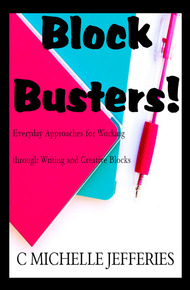
Block Busters is the easy to understand and use, go-to book for when that dreaded creative block hits you. With approaches from creative to physical and somatic there's pages of activities and things to try to bust through that block.
"This is a great resource for any writer experiencing any type of block."
– Janet Lott"I was a bit skeptical at first, but, I am surprised these actually work. Definitely keeping a copy of this on my desk."
– Nikki Holje"Somatics! One of my favorite subjects, applied to writers block! Who'd have thought! I'm so excited that this book exists. Tried the scribbling last night. Totally works. Thanks C Michelle Jefferies for another good writing book."
– Trudee R AlvisWe all know writer's or creative block. It's a terrible malady that strikes at the worst time and can hang on like burrs on wool socks. It can be from several sources. Stress, anxiety, deadlines, burn out-the mild kind, the severe and anything in between. There's several reasons and causes to blocks. But the focus of this book is to discuss the approaches to overcoming them.
Sometimes blocks can be alleviated by simple methods, which we will discuss here. Sometimes when blocks are created by things like burn out or trauma or even more severe types like PTSD or c(C)PTSD, it doesn't just go away with simple approaches. Often times when something like that happens, the trauma or reason behind the block ends up being buried in the body instead of the mind. And easy practical approaches fail and the blocks persist. There are things to do to tackle these issues as well, and we will discuss some of them too.
Keep in mind I am not a clinical therapist, psychologist or counselor. I do not have a degree in psychology. But I do have a certificate in non-clinical art therapy practices and some years' experience of working on and overcoming trauma caused and based blocks.
Dr. Bessel van der Kolk, in his book The Body Keeps the Score talks about how in his psychiatric practice in the 1970's noticed that talk therapy was somewhat effective but that his patients were still hanging onto trauma and memories of their past. And with the recent discovery of psychotropic medicine the other practitioners were now relying on medicine to make patients feel better and older therapies were being un-used.
The problem was that while patients were feeling better temporarily, they would reach points where meds would need higher potencies, different medicines or just wouldn't work on specific people.
He was noticing that people were exhibiting physical symptoms in relation to traumatic events that should have been taken care of through medicine or talk therapy. Some were experiencing late onset auto-immune diseases in mid-life. Some of them had seemingly good childhoods with no obvious (to them) negative experiences. Others were experiencing issues on specific dates throughout their lifetimes that corresponded to traumatic events in their pasts. None of these events were solely related to the emotional mind or the medical brain, yet all of them had something in common . . . the physical body reacting to trauma.
Enter Somatics.
The word Somatic means relating to or affecting the body, especially as distinguished from the mind. *Merriam-Webster The word comes from the Greek word soma, which means "body". Depending on the context, the term applies across medicine, biology, and mental health. *Harvard Health Diving down into the medical application it pertains to physical body tissue and functions rather than mental or emotional states. For example, somatic symptoms are physical signs-like a stomachache or a headache-triggered by stress or psychological distress. *Vocabulary.com And when relating to psychology and therapy, it relates to the connection between the mind and physical sensations. Somatic therapy or practices use body awareness, movement, and breathing to help process stress, trauma, and tension stored within the physical body. *The Somatic Project