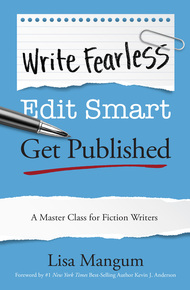
Lisa Mangum has worked in publishing for nearly thirty years. She was named Editorial Director of Shadow Mountain in 2026 and has worked with several award-winning and New York Times best-selling authors.
Lisa is also the author of four national best-selling YA novels (The Hourglass Door trilogy and After Hello), several short stories and novellas, and a nonfiction book about the craft of writing based on the TV show Supernatural. Her most recent book, Write Fearless. Edit Smart. Get Published.: A Master Class for Fiction Writers, was awarded Utah's Best of State award for nonfiction in 2024.
She regularly teaches at writing conferences across the country as well as hosts a writing weekend twice a year in Capitol Reef National Park.
Wherever you are in your author's journey, this book is like teaming up with a personal writing coach who has more than a quarter century of editorial and publishing advice.
Thousands of writers--from first-time authors to #1 New York Times best-selling authors--have learned from Lisa Mangum's masterful literary advice and inspiration. Now she's collected the best of her writing and editing tips in this helpful book that covers the entire writing and querying process, from nurturing a story idea all the way to submitting a polished manuscript.
In the first half of the book, Lisa guides readers through the various steps of the writing process, including starting the story in the right place, developing characters with high-stake goals, mapping character relationships for increased conflict, and introducing tension and plot twists. She also shares tips and tricks for nailing a satisfying ending as well as helping authors discover their own unique voice that can help them break through writer's block.
With her decades of experience, Lisa then takes writers on a behind-the-scenes tour of the many levels of editing, including a handy flowchart that unravels the mystery of where the commas go in a sentence.
Finally, she helps writers prepare to "get published" by deconstructing what makes a query letter catch an editor's eye and how to answer the all-important question: "What's your book about?"
Packed with Lisa's own personal stories of encouragement and inspiration, Write Fearless. Edit Smart. Get Published. is a literary adventure that's as fun as it is informative.
"Enough nuggets of wisdom on editing and finding an agent to make it worth aspiring novelists' time."
– Publishers Weekly"Built for authors at all levels, this handbook delivers poignant personal experience from an author and editor about the necessary tools, mindset, and motivation for creatives to bring their ideas to the page....It's a reference to treasure."
– Kevin Ikenberry, international best-selling author of The Crossing"Lisa Mangum has managed to distill a lifetime of writing wisdom into these pages. Every writer, at any stage in their career, has something profound to learn from this book."
– Jennifer A. Nielsen, #1 New York Times best-selling author"Mangum's craft book is filled with useful tips for the novice and more tried author alike, but what really stands out is the message of hope. Mangum's words will encourage you to reach until you feel as though you can touch the sky."
– Tricia Levenseller, New York Times and USA Today best-selling authorIntroduction
So You Want to Write a Book
Welcome, fellow writer! It's good to see you on this path. Crafting stories is a beautiful and exciting adventure with plenty of other storytellers to keep you company. I love the willingness of the storytelling community to reach out a hand and help each other, so while there might be a few bumps and maybe a detour or two along the way, know that you do not walk alone.
A couple of quick notes before we begin: While I hope you find support and advice in these pages, this book is not intended to be definitive, exhaustive, or all-encompassing. Instead, I hope it provides an introduction to a wide variety of topics related to writing, editing, and publishing. I hope it gives you some practical tools that you can apply to your own manuscript and some questions to ask yourself that might help you look at your story with fresh eyes.
As with any book about writing, take what works for you and your story and feel free to leave the rest behind. If you are still looking for guidance on a specific part of writing or editing after you finish this book, the Recommended Resources list I've included at the back of the book offers many additional titles to explore.
I know you have a story of your own to tell, and I can't wait to hear it. I hope you don't mind if I start with a story of my own.
My Origin Story
Every protagonist has a backstory. Here's mine:
Once upon a time, there was a little girl who loved to read. She read Mouse Soup, and how "[Olly's] room [was] an awful mess." And when she was still really young--maybe four or five years old--she took a copy of The Secret Garden to her mom and said, "Read this to me." So, her mom sat with the little girl in a big, green rocking chair and read to her the story of Mary and Colin and Dickon.
Of gardens and growing.
Of healing and joy.
Perhaps, then, it is no surprise that the little girl grew up with an abiding love of words and a strong respect for the power of stories and the people who tell them.
The Story Business
I love books. I always have. Books are my comfort and my safety. They are my reward and my escape.
Two quick stories to illustrate the kind of reader I was as a child:
When I was in elementary school, I volunteered to help in the library instead of going outside for recess. I still remember the feeling I had when, one day, I returned a book to the school library only to discover I had never checked it out in the first place. I had simply gone to the library, taken the book, and wandered back to my desk. I was mortified. I had stolen a book from the library! Never mind that I had returned it on time and in perfect condition; it was the principle of the thing.
Story number two: In middle school, I'd go with my mom to parent-teacher conference. I would browse the book fair in the cafeteria while she listened to all my teachers heap praise and gold stars upon my name.
Then, when Mom came to fetch me, it was easy to say, "Since I've been such a good student, will you buy these books for me?" I always went home with a stack of seven or eight books in my hands--which would last about, oh, seven or eight days.
Mom loved books as much as I did. She was a writer who wrote cookbooks and biographies and developed board games and card games, so I grew up knowing that writing was a Thing People Did, a job that maybe I could do one day as well. So, I wrote all the time--short stories, fragments of novels, really bad poetry--because I knew, I just knew that I'd write a book someday.
My mother shared her love of words and her incredible drive for creativity with me. She taught me how to build strong character relationships, how to plot a book from start to finish, and how to weave symbolism into a story. She taught me about dialogue and how powerful language could be. She taught me the proofreading marks and how to use them. She reminded me to pay attention to every single character and letter and word on the page--as well as to what was not on the page but should be.
I would read books aloud to her while she made cookies or crocheted afghans, and we would have long conversations about the benefits, beauty, and unparalleled practicality of paper clips.
It was my mother who would tell me, "This is great!" or, "This needs work." Most often, though, she would tell me firmly and without hesitation, "You can do it!"
And I believed her with my whole heart and soul--
All the way up until eighth grade, when I had an assignment to write my autobiography, and I wrote this: "I've tried my hand at painting and writing and frankly, the first time was the charm. My painting was pretty good for a fifth grader and writing, well I only have a few works that I'm really proud of. 'Follow Your Dreams' is the only one. I have a lot of ideas for stories, but I wasn't born with the talent for writing, so my ideas will just stay ideas."
Somehow, I had stopped listening to my mother's voice and had started listening to the voice of self-doubt in the back of my head that said, "You can't do it. You shouldn't do it. Don't you dare even try."
I thought I didn't have the talent to be a writer.
I thought I wasn't allowed to share my stories or my voice.
From then on, I believed that writing was a Thing Other People Did. Not something I could do.
The Editing Business
But my mom was also an editor, so I grew up knowing that editing was a Thing People Did, a job that maybe I could do one day as well. If I couldn't be a writer, maybe I could still do something else that my mom did. One way or another, I wanted to be in the word business--the story business.
I began working in publishing in 1997--a career currently comprising more than 25 years, more than 720 books edited, and at least 35,000 rejection letters sent--but my editing journey actually started in 1992. That was the year I began to make plans to go to college, and my mom encouraged me to write to some book editors for advice, which I did. I wrote to lots of editors, asking which classes I should take in college if I wanted to someday do what they did.
I received several replies. Some helpful, others less so, but the one that stood out to me was from Madeleine Robins at TOR. She wrote me a detailed, two-page letter filled with advice and encouragement and warnings, and it was her letter, in part, that helped me believe I could have a future in editing at a publishing house.
I graduated from the University of Utah in 1997 with a bachelor's degree in English, and I immediately applied to be the children's book buyer for a local publishing house, Deseret Book. I had worked at Waldenbooks to put myself through college, and while I didn't have all the required experience that being a book buyer called for, I thought it might be a "fake it until you make it" situation. Secretly, I hoped that if I got the job, maybe I could wiggle my way over to production and the editorial team, which is where I really wanted to be.
I applied for the job--and I didn't get it.
Shortly after, however, I got a phone call from Deseret Book's production manager, Anne Sheffield, who said, "We got your application, and we'd like to invite you to work in the production department as one of our freelance proofreaders." (I guess my plan worked after all.)
I took the proofreading test--grammar, spelling, punctuation, plus some cold proofreading and copy-to-copy proofreading work--and got the highest score anyone had ever earned on the test. Just one month after I graduated from college, I was working in my chosen field, albeit on a freelance basis.
A few months later, my mom, who was the assistant managing editor for a national magazine, called me and said, "Keep an eye on Bookcraft Publishers. They are going to have an opening in the editorial department. I know because we are hiring one of their editors to come work for us."
When Bookcraft posted an opening for an assistant editor, I dutifully applied. I took their proofreading test. And got the highest score they had seen on that test.
And I didn't get the job.
Shortly after, however, I got a phone call from Bookcraft's editorial manager, Cory Maxwell, saying, "We would like you to come in for an interview for an editorial assistant position." (I learned later that the company essentially created an entry-level position in order to hire me.)
Four months after my college graduation, I was working full time as an editorial assistant at a publishing house. Two years later, in 1999, Deseret Book Company acquired Bookcraft, and I've been at Deseret Book Company ever since. In 2014, Chris Schoebinger asked me to be managing editor of Shadow Mountain, the national imprint of Deseret Book, which I immediately accepted.
Oh, and along the way, I discovered something amazing. It turned out that writing was a Thing I Could Do after all, and I was able to write and publish four best-selling and award-winning young adult novels.
Being an editor is a wildly exciting profession. Exhausting? Yes. Stressful? Sure. But at the core, it's all about reading books and helping them shine as brightly as they can. It is a dream job for me.
Your Origin Story
You might have a similar dream of becoming a writer or maybe even an editor. Perhaps you already have turned your eyes toward the possibility of publication. I'm excited to share my editing expertise and writing experience to help show you how to make your writing the best it can be.
If you are just starting out, staring at that first blank page and wondering how to even begin, there are chapters in this book that can help you find and develop your ideas. There are sections devoted to developing characters and showing you how to use those character relationships to generate conflict. There are helpful guideposts to direct you toward the climactic summit of your story, and there are encouraging stories and suggestions to empower you to break through the obstacles that might stand in your way.
When you are ready to turn to editing, you'll find my best advice for how to tackle developmental edits and revisions as well as how to become a master of punctuation and corral those pesky commas into place.
Then we'll turn our attention to writing query letters and to tips for pitching your book to an agent, editor, or publisher.
Before we embark on this journey together, I want you to take a minute to think about some important questions:
What's your origin story? Where did your dream begin? What does it look like? What does it feel like inside you?
Maybe your dream is to be published or to finish a manuscript or to learn a new skill. Whatever it is, visualize it. Hold it in your mind and in your heart. Write it down in as much detail as you can. Got it?
Good.
Let's get started.