Born in 1976 in Italy, Andrea Contato is a researcher in the history of videogames, a novelist, and a writer of non-fiction books and essays. Among his works are Through the Moongate: The Story of Richard Garriott, Origin Systems Inc., and Ultima, the biography of one of the best-known video game pioneers, Cabel Electronic, a book about an Italian console manufacturer operating between 1977 and 1984, and Video Games: The People, Games, and Companies, a series of five books about general video game history.
LucasArts was one of the most important and beloved computer game companies of the 1990s. In addition to revolutionizing the graphic adventure genre, it published some of the most acclaimed and influential combat and space simulators in history.
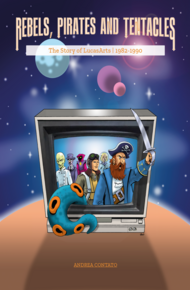
This book tells the great story of LucasArts, from its origins through 1990, exploring the founding of the division, the development of its games and technologies, and the people behind its most celebrated titles.
Drawing on extensive documentary research and numerous previously unpublished interviews, the book presents new information and an original historical account of the company's formative years.
Games featured in the book include Ballblazer, Rescue on Fractalus!, Koronis Rift, The Eidolon, Habitat, Labyrinth: The Computer Game, Maniac Mansion, Zak McKracken and the Alien Mindbenders, Battlehawks 1942, Indiana Jones and the Last Crusade: The Graphic Adventure, Their Finest Hour: The Battle of Britain, Loom, and The Secret of Monkey Island.
While George Lucas may primarily be known as a movie maker, his fascination with technology also led to him creating this game development studio, which created some of the most foundation gales of the 20th century. Historian Andrea Contato delves into the early history with Atari and Commodore computers, along with the beginnings of what would become a point-and-click empire with Maniac Mansion and The Secret of Monkey Island.
While George Lucas may primarily be known as a movie maker, his fascination with technology also led to him creating this game development studio, which created some of the most foundation gales of the 20th century. Historian Andrea Contato delves into the early history with Atari and Commodore computers, along with the beginnings of what would become a point-and-click empire with Maniac Mansion and The Secret of Monkey Island. – Kurt Kalata
"Andrea Contato has compiled a remarkable collection of interviews, articles, and little-known anecdotes into a compelling narrative. It covers the circumstances leading up to the creation of our company and its first few years. I was delighted to find it is not only a comprehensive history of our work, but contains many facts and details that I was not aware of despite having lived through those years myself."
– Noah Falstein, Director of Experience Design, George Lucas Educational Foundation."If you love the era of point-and-click adventures, have ever wondered what gave those games their distinctive feel, or simply want to understand how a company culture capable of transforming a genre takes shape, you'll find a thoughtful and passionate answer here."
– Marcello Paolillo, Spaziogames.it"Simply unmissable for anyone who loved the legendary LucasArts."
– A readerThe Secret of Monkey Island™
After working on Maniac Mansion, Gilbert spent a long time searching for a subject on which to base his new game. He knew it would be an adventure, and he also knew that he could put the experience he had gained programming Maniac Mansion to good use in an attempt to avoid repeating some of the mistakes and flaws that had inevitably emerged during the development of his first adventure. In the old Lucasfilm Games tradition, Gilbert began writing various design documents, devising plots and settings and submitting them to his colleagues. His first attempts came to nothing—none of the proposals gained enough momentum—but, while searching for a suitable and convincing subject capable of generating enthusiasm among the other designers, he took the opportunity to reflect deeply on the graphic adventure genre, on what he had learned while developing Maniac Mansion, and on what the key characteristics of a successful product should be.
Some of his thoughts later appeared in an article with the ironic title Why Adventure Games Suck and What We Can Do About It, published in The Journal of Computer Game Design, volume 3, number 2, in December 1989. Gilbert identified around a dozen critical points, including: the game's objectives had to be clear and divided into secondary goals whose nature had to be evident to the player; the game should not punish the player, who had to be given the opportunity to learn without resorting to trial and error and repeatedly reloading the game; indeed, in this regard, according to the designer, the save feature should be useful only for suspending a game and not for going back to correct a mistake, recover an object that had been lost or missed, or avoid an inevitable death; puzzles had to advance the story rather than simply keep the player occupied, while solving them—and, more generally, progressing through the adventure—had to be rewarding, in order to maintain the player's attention and provide a sense of progress; the player had to be free to explore, set aside—at least temporarily—puzzles they could not solve, and devote themselves to something else.
For reasons different from Moriarty's, Gilbert also agreed that the classic design strategies of graphic adventures—or text adventures, which by then had almost completely disappeared—had serious limitations: in an attempt to keep players occupied for as long as possible—which, according to the designer, was due to the retail price of software, by then around $50, for which buyers felt entitled to at least twenty hours of gameplay—the length of adventures was artificially extended with puzzles that were sometimes too difficult, unintuitive, whose nature was not clearly explained to the player, or that were completely disconnected from the story and tacked on, sometimes together with endless and complex mazes. Moriarty had solved the problem by simplifying the puzzles, immersing the player in a fascinating world with an exciting story, and providing a linear gaming experience, like an interactive movie. Gilbert had a different idea: as a designer, he had to be honest with the player, creating puzzles that served the story, providing clear objectives from the very beginning, rewarding the player step by step, without punishing them with unavoidable deaths, without trapping them in dead ends, and leaving them free to explore and choose which puzzles to tackle, but in moderation, carefully pacing the introduction of new areas to explore, new characters to talk to, and new things to do.
Gilbert's other major reflection concerned the competition. Despite the substantial growth in sales of Lucasfilm Games' adventures—which had by then reached hundreds of thousands of copies with Indiana Jones and had gotten off to a very strong start with Loom—the market was firmly in the hands of Sierra On-Line. The designer wondered why and, comparing the output of the two software houses, came to the conclusion that one of the main reasons Roberta Williams's adventures were so popular was her preference for fantasy settings.
Gilbert: " I was also thinking about games like King's Quest. At the time – I mean, really the entire time – King's Quest and the games from Sierra sold a lot better than Lucasfilm Games did in the U.S. The situation was reversed in Europe, where Lucasfilm sold much better than Sierra. But in the U.S., Sierra was just selling a lot better, and I was really trying to figure out why. I think that with King's Quest, you had a fantasy environment, which was very popular back then (and it still is today). Fantasy is a huge genre in games, and King's Quest had that fantasy vibe. I started wondering if that was one of the things that made it so successful. But I don't really like fantasy – I'm not a big fantasy fan. I don't read fantasy. I mean, I'll go to Lord of the Rings movies and stuff, but I'm not a big fan. I didn't really want to make a game about dragons and such. So I started thinking more, and that's where ideas like pirates came up. You know, pirates actually share a lot in common with fantasy. I thought, maybe if I made a game about pirates, I could sort of do 'fantasy' without actually doing fantasy, which I didn't really like. That's really where the whole idea of Pirates came from."
The pirates Gilbert wanted to draw inspiration from, however, had little to do with the real pirates described in history books. They had more in common with those of certain swashbuckling films and adventure novels from the second half of the nineteenth century, although the designer's true source of inspiration—at least initially—once again came from Disney.
Gilbert: "One of my favorite rides in Disneyland is Pirates of the Caribbean. You get on a little boat and it takes you through a pirate adventure, climaxing in a cannon fight between two big pirate ships. Your boat keeps you moving through the adventure, but I've always wished I could get off and wander around, learn more about the characters, and find a way onto those pirate ships. So with The Secret of Monkey Island™ I wanted to create a game that had the same flavor, but where you could step off the boat and enter that whole storybook world. The pirates on Monkey Island aren't like real pirates, who were slimy and vicious, the terrorists of the 17th century. These are swashbuckling fun-loving pirates, like the ones in the adventure stories everyone grows up with."
Once he had chosen the setting, Gilbert did not experience the same creative flow that had allowed Moriarty to write the story of Loom in a week and immediately begin working on the game. For six months, he continued to revise the plot, making major changes, but then had to put everything aside because Falstein needed help with Indiana Jones. Once the emergency was over, he returned to work on the pirate game, drafting further documents, two of which survived thanks to Wilmunder, who preserved them and published them on his personal website in 2017.
From these two documents—one containing a summary of the story and background, and the other a step-by-step outline of the game flow—it is possible to date them approximately to the second half of 1989, when the Indiana Jones graphic adventure was at an advanced stage of development or had just been completed. Gilbert's proposed game still had the working title Mutiny on Monkey Island and had very little in common with the game that would be released a year later. The islands of Mêlée and Monkey were already there, as was the Governor—a character provisionally named Fat, who, however, played the role of the story's antagonist—and there was a map leading to a legendary treasure, which was actually a ploy to "recruit" crews of ghost pirates through an ancient curse. The adventure's main character, named Smear West, was not a young and naïve aspiring pirate at all, but an already famous pirate, known throughout the Caribbean for his previous successful exploits.
The game's gameplay was also very different from what would later take shape. The first part was structured as a graphic adventure and had the player exploring Mêlée Island to meet its inhabitants, look for suitable candidates for the crew, and convince them to join. This was complicated by the fact that some characters had rivalries that emerged as the player got to know them better, revealing that certain recruitments were mutually exclusive and that adding some pirates to the crew therefore prevented others from being recruited, in a mechanic that once again recalled the one devised for I Was a Teenage Lobot™ but never implemented.
Once the preparation phase was over—which was intended to last almost a third of the game—there was a section that closely resembled the strategic map portion of Sid Meier's Pirates!: the player roamed the seas, exploring and, when necessary, fighting other vessels, engaging them at a distance with cannons—operated automatically by the computer—in an action sequence that, in the designer's own words, "is very similar to the biplane sequence in Indy III." The purpose of these encounters was to acquire cargo to sell in order to resupply the ship and repeat the loop until Monkey Island was discovered, after which the gameplay returned to the graphic adventure format, with the exploration of the island, the discovery of the Governor's secret and how to defeat him, the preparations, and the final battle.