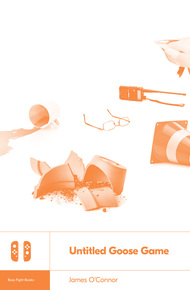
It's a beautiful day in the village, and you are a horrible goose, ready to wreak charming havoc on the weary locals. You'll ruin their gardens, invade their pub, and terrorize their children. What kind of scoundrels would make such a devious game?
Before the critical acclaim, the tweets from celebrities, the major awards, the memes, the fan art, and the legion of players, Untitled Goose Game was just the goofy dream of House House, four friends in Melbourne, Australia. What began with a photo of a goose and the joking caption "Let's make a game about this" transformed into one of the wittiest and most stylish games of its generation.
Through interviews with the creators and their co-conspirators, journalist and developer James O'Connor tells the story of how this indie megahit came to be, revealing how the team succeeded by evolving their friendship into an art practice, contributing to the wider Australian game development scene, trusting their own good taste, and never, ever naming their game. Honk!!
It's a silly little game about a goose causing mischief, but this Boss Fight Books entry talks not only about its development but also the history of the Australian game industry, and how it came together to create this beloved title. – Kurt Kalata
"A fascinating behind-the-scenes story, but the game ended up being a perfect entry point to talk about developer House House and the broader Australian game development community."
– Polygon"As charming as the game that inspired it, Untitled Goose Game delightfully tells the story about how one of Australia's most popular games came to be. James is a talented writer and interviewer, who sweetly balances technical game speak with fun development anecdotes. This is an essential read for fans of The Goose and anyone who wants a primer on the diverse Australian game development industry."
– Goodreads review"This was a fantastic read that gave insight into the Aussie game dev industry I didn't know I wanted. After reading stories of how terrible game dev can be it was nice to just have a fun story about how a game about a goose came to be."
– Goodreads review"The largely wholesome story of a bunch of friends who just wanted to get together to make a fun game, who succeeded at that, and were so clueless about their accomplishment they failed to read hints that maybe they should attend a certain award ceremony."
– Old School GamerLET'S MAKE A GAME ABOUT THIS
On August 11, 2016, Stuart made his Slack post about a goose. "Let's make a game about this," he wrote, posting a stock image of a lovely white goose. The team spent part of the next day unpacking the joke. "Best thing about a goose is the bit above their nose," Stuart said. "It's really crazy that their nose and legs are bright orange," Michael added, his art school credentials showing. Nico, perhaps unconsciously recalling his work on Ancient Greek Geometry, focused right in on what makes the goose's shape interesting: "They are very big, but then have tiny tails."
The team had their fun, then got back to work figuring out their next project. They bounced ideas back and forth with varying levels of seriousness. They worked on Pinolo. The goose suggestion fit into a specific category of joke suggestions, the "what if this innocuous thing was a video game" category that the team sometimes dipped into. It's a fun mental exercise, imagining how you might go about designing something hyper-specific. The team often shared pictures of other animals, gifs of memes, and funny videos in Slack, imagining what a game about each object or concept might look like. The aim was to make the others laugh rather than finding a million-dollar idea. "I was very happy to just throw a bunch of ideas out there," Jake remembers. "Most of them didn't get a response until the next morning. I really had to push to get any kind of engagement." Stuart describes this as "fantasy game making"—imagining a funny game that the team, at the time, had no intention of creating.
Michael's tweet about Stuart's Slack post, which shared his post and their responses, didn't blow up at the time. It now has well over 11,000 likes, but these came quite a bit later, when Michael retweeted the post—by then, House House had followed through on the joke. "If we'd thought that it was actually going to be a project, I obviously wouldn't have tweeted it," Michael tells me.
Stuart recalls the team having a lot of discussions about making games about "building" around this time. Minecraft (Mojang Studios, 2011), Nico's favorite game, embodied many of House House's core philosophies, and the idea of players building their own play spaces appealed to them. They wanted something different from Push Me Pull You, a 3D game with a single-player mode, which could reach new audiences. But it also needed to be achievable, a game that a small team of amateur developers could create without burning themselves out.
But as the four of them worked through ideas, they kept returning to the concept of a game about a goose. Over time, it felt less and less like a joke. Imagine that the goose wanders into a church fête (a British public community festival centered around a church), one of them suggested—what would it do there? The goose wants to tip over a trestle table: How might it do that? How might people react? What impact would it have on the fête?
As the team created the third-person character controller for Pinolo, they imagined how it could be applied to a waddling little fowl. "Whatever we were working on at the time," Stuart says, "we could sort of see through the lens of, like, 'Oh, if this was in that goose game, this is how this bit would work, and this is how this bit would work.'"
While the team had struggled with finding a context for "Pinolo," discussion of the goose game was all context. They'd imagine a goose wandering into a scenario or setting and immediately riff on what the bird might do, how people might react to it, and how the scene could escalate. "There was a day when we realized that the things we were trying to achieve with this Pinolo game, we could do with this goose game idea, and then we'd have a bigger direction for it," Nico says. "So we kind of stopped working on Pinolo and started working on Untitled Goose Game at that moment."
Pinolo may not have gotten his own game, or become a real boy, but he does have a little cameo in Untitled Goose Game. In the High Street area, the televisions in the TV store show a loop of Pinolo rolling a ball—until the goose breaks in and takes over the airwaves. "That's our one concession to our history as a studio," Stuart says.
●
"The process of designing [Untitled Goose Game] was starting with a model of a goose, and going, 'Oh, what can we do with this?'" Jake told the AIS Game Maker's podcast in 2020. "The whole game was felt out in that way. We started with this one main ingredient, and had a sense of where we wanted it to go, but really it was about letting this goose snowball and pick up mechanics, and pick up ideas."
During the development of Push Me Pull You, the team had moved from one office to another. The first, offered through the organization Renew Australia as part of their Docklands Spaces project, was incredibly cheap (somewhere between $40 and $100 a month), situated in a newly-renovated block building where few spaces were being rented. The initiative was aiming to draw small companies in to reinvigorate the area. It was ideal for a team without any income. After a year, House House moved to a slightly less cheap space in Collingwood, which was located above a commercial cleaning business. In 2016, around the time that Push Me Pull You was released, that space was purchased by a company that planned to build apartments in the adjacent block.
Later in 2016, House House settled into the office that most of Untitled Goose Game's development happened out of, a converted upstairs apartment that was shared with two other studios, Paper House (Paperbark, 2018) and 2pt Interactive (Heavenly Bodies, 2021). The team had a new office, other developers to share space with and talk to, and enough money from Push Me Pull You sales to pay the rent. They were well-situated to start working on the goose game that they found themselves increasingly convinced was a good idea.
In the early planning stages, the rough concept for Untitled Goose Game (which was, at that point, just a lowercase untitled goose game) still revolved around a church fête. The idea was to have a single large location filled with characters, and the goose would cause mischief in a way that would ripple through the whole space. In an interview with Vulture in 2019, Michael described how this fête would have featured "a huge crowd of people," each going about their days, their paths and lives overlapping as the goose wrought havoc. But they soon realized that designing a single huge space with so many moving parts would be extremely difficult. Systemic gameplay would be much easier to design in more contained spaces with fewer characters. The team started small: one goose, one human, one environment.
The first elements designed for Untitled Goose Game are the ones you see shortly after you start the game: the lake, the garden, the groundskeeper, and the goose itself. The garden is based on Jake's grandparents' yard, but tweaked to account for the goose: There had to be places to hide, items to grab, a sense of order to mess with. The goose itself is a simple design: long neck, dot-point eyes, three colors in total. Simple, elegant, beautiful—and kind of funny to look at.
Several of the game's major aesthetic influences, at that early stage and throughout development, were children's shows set in quaint English towns. Fireman Sam, Postman Pat, Brum, Wallace & Gromit, Thomas the Tank Engine—shows that were run frequently on Australian television during the early-to-mid 90s, when the members of House House were children. Fireman Sam and Postman Pat, in particular, were shows about people whose personalities and societal roles were defined by their jobs, shows in which sensible, pleasant adults often had to teach lessons to mischievous children. As a kid, my nan often jokingly compared me to Norman, the naughty lad from Fireman Sam whose mother was always losing track of him. Growing up, it's far easier to relate to the naughty child characters than the strait-laced adults the shows are named after. It's not a big leap to imagine entering the worlds of these shows and causing havoc for the quaint, serious adults that do not like to see their strict routines disrupted. It would make total sense for a goose to cause trouble on Fireman Sam.
So it was that their prototype emerged. There was a goose, and a man for the goose to harass. The goose could grab the man's possessions, stretching his funny long neck out to grab them in his beak, and pull them out of the garden. The goose could drag all of the man's possessions into the lake, steal his radio and hide it from him, or just run right at him, honking and flapping.
It did not take long for a clear sense of identity to emerge from this prototype. While Push Me Pull You had hit the market as the wave of similar games was waning, Untitled Goose Game was evergreen. There was no trend wave that it obviously rode, no other game you could point to and say, "It's like this one." There's no boiling it down into a "X meets Y with a dash of Z" formula. The most oft-cited comparisons are the Metal Gear Solid and Hitman series, big-budget experiences that Untitled Goose Game is not really trying to replicate—you cannot kill anyone here, just bother them.
At the beginning of development, the team's work model was the same as the one they'd used on Push Me Pull You. Everyone touched everything, learning how to make the game one step at a time. Over the course of development, the team specialized more—not too much, but they got better at identifying who was the best person for each slice of work. For their first game, the team had posted sticky notes on the wall listing all the jobs that needed doing, and everyone worked together from that list, taking the notes they wanted to tackle next. For Untitled Goose Game, they changed to a shared spreadsheet—a less messy solution. They tracked each job, who was going to do it, and whether it was done or not—about as straightforward a model for task tracking as possible. There was no formalized production process, no use of common organizational programs like Jira or Trello. To this day, the team still doesn't use traditional production processes. They have, over time, figured out their own way of making games together.