Introduction
It seems strange to start a book with an apology, but here we are. I know for some older readers I have been born too late; since I'm a Millennial, this work doesn't delve too deeply into the origins of the magic word "xyzzy" in Colossal Cave Adventure (1975), which could whisk the player into the game's cave system. I never experienced first-hand the joys of type-in programs on home computers like the ZX Spectrum and Commodore 64, having to learn about them second-hand from scanned copies of magazines on the Internet Archive.
Some younger readers might also feel that I was born too late, given I've decided cheating is a topic worth exploring. These days, cheating is considered off-limits, as many popular titles like Fortnite are designed to stop players from giving themselves an unfair advantage.
This book isn't aimed at people of a certain age, but rather those who find the subject of cheating intriguing, even if they don't make a habit of it themselves when playing modern games. These are the kind of people I spoke to when first researching this book in 2020, when I created multiple shadowy sock puppet accounts to ask the same two questions:
"What's your favorite video game cheat?"
"What's the first video game cheat you ever used?"
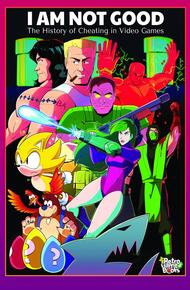
As far as the latter is concerned, I remember being on a camping trip as a Cub Scout in 1993. I was telling/boasting to my contemporaries that my parents had, at great personal expense, bought an Acorn Archimedes on which my brother and I had eagerly started playing Lemmings. I said that I was having severe difficulty with a certain level, and a fellow cub casually dropped into the conversation that if I entered the password "IAMNOTGOOD," I'd be able to skip levels just by tapping the spacebar.
I was hooked. Armed with my trusty space bar I breezed through the difficulty levels Fun, Tricky, Taxing, and Mayhem then on to the secret levels. This was followed up with a cheat I discovered for myself playing the arcade version of Altered Beast (1988), where you could hold down A and tap start repeatedly to continue from the same point each time you died.
No doubt you, the reader, will have your own personal account of the cheats you came to know and love.
This book is broadly structured chronologically, starting with the early days of cheating. Together we'll delve into the likes of the Konami Code, cheating devices like the Action Replay and Game Genie, as well as some popular urban legends: the cheats that everyone knew about, but never actually existed.
Still, I know some of you will still feel I've come up short if I haven't covered your particular cheat of choice. So please accept my apologies that this isn't an encyclopedia. If you need a database, there are websites for that. I've even listed a few towards the end of the book.
I've tried to be democratic: I took careful note of the favorite cheats people mentioned during my research. Doom's "IDDQD," for instance, was a top contender, so I've devoted a chapter to the rise of god mode. Many posters also swore that they'd enjoyed cheats that never really existed, so I've written a chapter on that too.
There'll also be purists who'll maintain that my definition of cheating doesn't match theirs. Is exploiting a glitch like Doom's Rocket Jump cheating, since it was never meant to be there? This seems like an overly rigid definition to me. After all, using a cheat device like the Action Replay to modify a game's memory addresses can produce results the original coders never intended.
Although the line can sometimes be blurred, I've also tried to steer clear of any obvious Easter Eggs. These are usually deliberately included for the sheer novelty, so they don't affect gameplay in any significant way.
Perhaps the easiest definition of cheating in video games is any action you take that makes the game significantly easier, such as gaining infinite health or ammo. Still, this ignores the number of cheats like Bioshock's 1999 mode that make gameplay more challenging. Some cheats, like the big head mode in titles like GoldenEye (1995), don't even serve any useful purposes beyond making play a little more novel.
So, what do we take away from this as gamers? The world of cheats is as diverse and complex as the video games themselves. Sometimes they're included for the benefit of developers and only discovered by the gaming public later. On other occasions cheats are deliberately coded into video games for players to enjoy. Experienced gamers also aren't above exploiting in-game glitches to give themselves an edge. This is why I hope readers can forgive my rather holistic interpretation of what a cheat is in this book.
We also can't ignore that the rise of online play has changed the landscape of cheating. Instead of being a personal choice for individual players, it now has the potential to ruin gaming for others. This is particularly true for competitive games, where developers are locked in a continual arms race with cheaters to prevent exploitative practices like aimbots. Since this kind of cheating has become a method for unscrupulous players to exploit one another, you'll notice that in this book I've only briefly touched on cheating in the modern era.
In the golden age, gaming cheats and exploits were often the only way to complete a game. This reflected the fact that storage media like cartridges were very limited. Without making titles fiendishly difficult gamers could complete them in hours. I don't insist that this was the only way developers could or did encourage repeat play. But the fact remains that if I had never learned to say "IAMNOTGOOD," I'd never have helped those little blue and green critters reach the final level.
This book is a tribute to that golden age and to all of you gamers everywhere: Don't stop cheating.